Showing posts with label rhythm. Show all posts

Monday, August 30, 2010

Why is it taking so LONG for me to strum well?!


When I was just beginning to play the banjo, a girlfriend and I attended a three day banjo workshop taught by Dwight Diller of West Virginia- a master clawhammer banjo player. We were both rank beginners. After the first day, I said to my friend “I just HATE that I sound like such an amateur, I HATE sounding like a total beginner. I wish I could play like Dwight!”. My wise friend said “Well
but don’t we sound like we are supposed to sound for having played just a few weeks? -We probably sound just like Dwight did when he had been playing for three weeks.” A simple concept, but it hit home for me... I saw that I should appreciate each stage of playing I am in at the moment, no matter how humble my beginner skills.

Strumming confidently on your dulcimer typically will takes months of playing. Strumming really well takes years. Don't give it a second thought when you still feel awkward after a few weeks. That's totally normal. Beginners are supposed to sound like beginners. I've been a beginner many times on various instruments or whenever I try to learn a new style. Embrace your beginnerdom...it's like the beginning phase of a great romance! Don't bang your head in frustration and feel inadequate ...rather enjoy the sweet rosy flush of new discovery.

I used to play mountain dulcimer in chord/flatpicking style, and I was pretty good at it- sounded very nice and I felt comfortable picking that way. I also had a little experience playing both mandolin and banjo.
But when I decided I wanted to start playing in traditional noter and drone style, I had to start right back at Square One again. It was a totally new thing for my right hand, and suddenly I was a brand new beginner all over again. Ackk!! The strumming was a whole different thing from all my other experiences, and I sounded very awkward, rhythm-wise. I stumbled constantly, felt embarrassed, and could not keep up or keep steady. All this while I was able to play banjo rhythm confidently!

It took me about 3 months to even get 'comfortable' on a basic level with my dulcimer strumming rhythm. Another several months to actually get decent and to be able to play at a fairly normal speed. About 3 years from starting that endeavor, I was able to sound 'good' -with a solid bounce and crisp syncopation, and I could play fairly fast. There are still some fiddle sessions these days that are simply too fast for me to keep up with. That's ok with me though, I don't feel driven to do everything well.

Now I have been learning to play the bowed psaltery for the past 10 months...and I'm starting from Square One as an awkward beginner all over again! But now I figure that learning is where much of the fun really lies. It's the journey, not the destination. It's the present moment that is most precious.

I have taught myself to enjoy the journey and the struggle more, so that I don't have to worry about the destination as much. The funny thing is, no matter how 'good' we get, our destination or ultimate goals seem to always remain just out of reach anyway, like a carrot on a stick. Meanwhile the journey, the moment, is right here in our hand to bring us delight if we only allow it to. Enjoy the romance of being a beginner, always learning and discovering ...and yes struggling too. Everything else will follow naturally in its proper time.

"Life is what happens to you while you're busy making other plans." -John Lennon

continue reading the rest of this post here...

Tuesday, February 23, 2010

Video: Muted strumming rhythm practice

Many new players understandably concentrate so hard on not making wrong notes that they tend to overlook trying to improve their strumming rhythms.
I remember well when I was just starting out playing banjo- West Virginia clawhammer banjo player Dwight Diller first taught me in his workshop, and he said "The right hand is the meat and potatoes, the left hand is just the gravy."- I always loved that!

So here is a way to really IMPROVE your strumming rhythm without driving others crazy! Try muted rhythm strums, it's actually fun! Includes some varied strum rhythms to practice.


continue reading the rest of this post here...

Friday, January 29, 2010

Video: Tips for beginners- Where to add the extra strums?

Here is a little explanation to help you figure out where to add those extra 'ditty' strums in a tune. It's especially hard for beginners to know where to add those little extras. Where do you strum 'bump-ditty' instead of just 'bump'?


continue reading the rest of this post here...

Tuesday, January 19, 2010

Video: Tips for beginners- Sugar Hill -part two

You can find the TAB to this old-time song earlier in this blog, HERE.
Beginner video #5. Starting to play the song Sugar Hill and incorporating some strum patterns and a slide.

continue reading the rest of this post here...

Sunday, January 17, 2010

Video: Tips for beginners- Sugar Hill -part one

You can find the TAB to this old-time song earlier in this blog, HERE.
Beginner video #4. Starting to play the song Sugar Hill and incorporating some strum patterns and a hammer-on.


continue reading the rest of this post here...

Friday, January 8, 2010

Video: Tips for Beginners- more on strumming motions

Here is a second video on basic strumming which goes over some of the motions you want for smooth strumming and some of the things to avoid:

continue reading the rest of this post here...

Tuesday, January 5, 2010

Video: Tips for beginners- STRUMMING

Here's a very quick video I recorded so beginners could practice a basic starting strum rhythm and strumming directions. I hope it's helpful to some folks.


continue reading the rest of this post here...

Monday, August 31, 2009

Limber Jack - Part One

I purchased a marvelous 'Limber Jack'.
Originally from Europe, limberjack dancing toys were made in Appalachia and the Ozark mountains. they are a very fun percussion 'instrument', and are easy to learn to work.
Here is a wonderful clip of Jean Ritchie playing her limberjack.
Here's John Kirk and Trish Miller and 'Jack' playing with their little friend Jack too. ;)

I better get practicing on it! I know the littlest children who come to the farmer's market in town (where we play fiddle and banjo) will just love it. They are always clapping their hands and dancing to the music when we play.

You can get your very own wonderful walnut wood hand-carved Limberjack from Keith Young, mountain dulcimer maker of Virginia: Keith's Limberjacks. Keith also made a beautiful curly maple mountain dulcimer for me 12 years ago.


Time for 'Jack' to get clogging!....


Here is a little video clip of "Cloggin' Clyde" from the the other day when we were playing music at our local farmer's market. Clyde is slowly getting his 'moves' together. ;D


Ok these English guys really know how to have fun!:


Here are my other two limberjacks- a Frenchman, and Mr. Pig...


UPDATE, March 2010-
I've now had some experience playing my limberjacks at farmers' markets and such.
There are some small children who barely look at them and seem jaded and uninterested, but then you get the other children who make it all worth while. Last summer, a group of four children, ranging from age 4 to 7 or so, stopped dead in their tracks at our local farmer's market and came running over to watch my limberjack dance. You wouldn't believe how HUGE their eyes got, like dinner plates!, and then they all started laughing and pointing in delight, and the more he danced the more they laughed. I swear the little wooden man was inspired to dance his very best! Then they started trying to dance like the limberjack, and they laughed even MORE, finally collapsing right there on the ground in a heap of child glee and belly laughs. It made me so happy! I think that was the very best audience I ever had. :)
I love playing my limberjacks. I have five of them now, all different. I may wind up with more eventually, I love them so. Plus, they are way cheaper than banjos or dulcimers!

Also- see my latest "Limberjack Part Two" post from 2010 HERE.

continue reading the rest of this post here...

Wednesday, March 11, 2009

All the Good Times


Here is a very nice simple traditional song- All the Good Times Are Past and Gone. It's especially good for beginners (are you with me, "papabill"?). I've presented it in the key of G, because that's the key I usually see it written out in. Also because you don't want to get stuck in the rut of only being able to play in the key of D... I've tabbed it for G 'reverse' ionian tuning (DGD). I presented a chart a few posts ago showing how to make the change from D 'regular' ionian into G 'reverse' ionian. Using the reverse ionian tuning sometimes can make the re-tuning process a little easier by changing the strings a bit less than going from regular D ionian to regular G ionian. I know that statement might be confusing- I am going to explain that a little further one day very soon. But do notice again that the song ends on fret 3, which gives us a hint that it's in ionian mode.
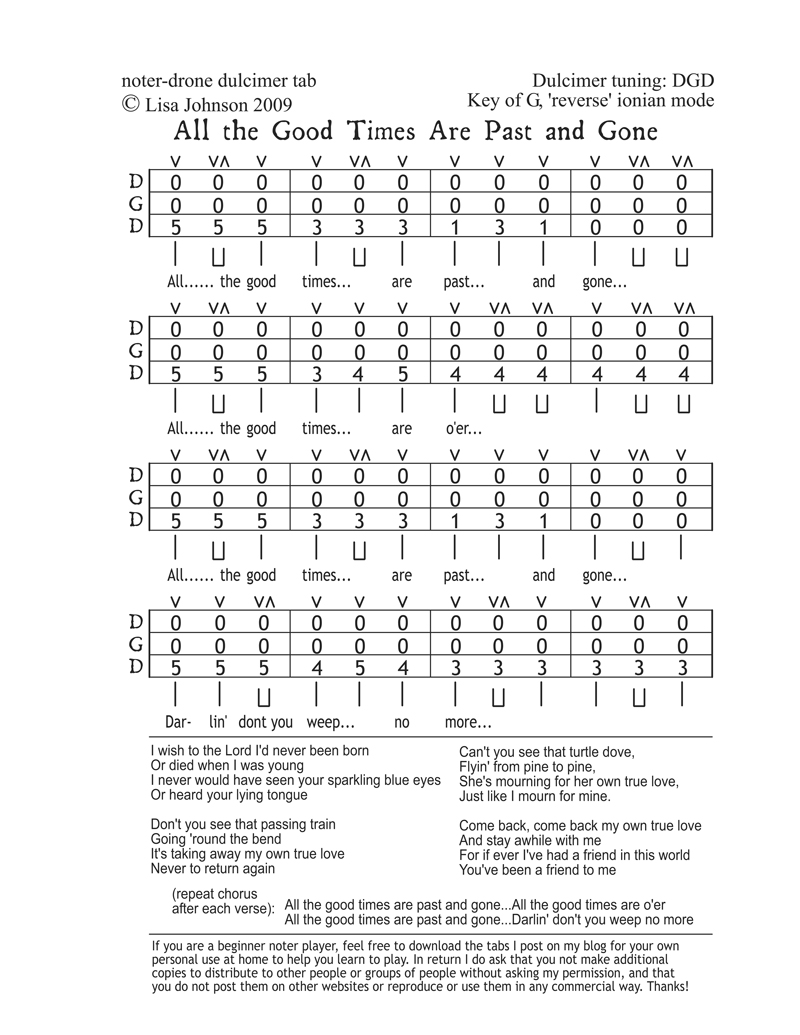
I know you probably are loathe to retune your dulcimer into the key of G from your 'comfort area' of being in D...but getting over the natural tendency to want to avoid re-tuning is going to allow you much greater freedom to play all kinds of songs and tunes later, and will give you the ability to play in fun jams of other music playing people... people who play in several different keys on other instruments. It's only hard and scary to change tunings the first few times you do it. After that it becomes much less of a big deal.

By the way- did you know the difference between a 'tune' and a 'song'? A tune is a piece of music usually with a melody, and a song is the same thing but with words/lyrics added to sing it. You sing a song, you play a tune. If you play a tune and then add words to it, it becomes a song!

"All the Good Times..." is a very good song to try to singing to while you play, since the first verse is pretty easy to memorize and sing on 'autopilot' while you play. Being able to sing a song while you play it is an immensely helpful skill to practice. It doesn't matter if you don't sing well at all, you can just sing by yourself all alone if you prefer. Having a slightly crude and rustic voice is actually something that's admired in old-time music! You'd sound pretty lame if you sang these old country songs in a trained operatic voice.
Practicing singing something simple while playing actually helps cement the song into your brain so that you can better play it without tab, and it helps you to keep rhythm better. Think of how easy it is to remember little children's songs from your youth- this is much the same thing. Plus, there may well come a time as you get to be a better player when you will actually want to sing songs with others, and if you practice this here and there during your early learning stages it won't be so hard to pick up the skill later.

As will all things, my advice is the same- start simple and slow, and don't get more complex until you feel comfortable. Remember this: it's far better to play 3 simple slow tunes well than to stumble awkwardly through 8 fancier tunes.
In this case, I'd suggest singing just the first few words with your dulcimer playing over and over: 'all the good times have past and gone'. Once you can play and sing that phrase comfortably, add the 'all the good times are o'er' to it. And so on. If you never get past the first verse, that's fine too!- at least you have shown yourself that you can do it.
Here is the song, in the key of G, ionian mode (but remember you can play the tab exactly the same way if you are tuned to D ionian tuning, DAA, as well):


continue reading the rest of this post here...

Saturday, March 7, 2009

Take your pick

Picks are a funny thing. One day you find what you think is the perfect pick, and then a few months later it just doesn't seem to be so great after all, and you suddenly find a different perfect pick. This simply means that the way we play is changing and evolving over time. This is a good thing, even though it means we may have to repeat our hunt for the right pick over and over. Funny how we seem to grow out of this ongoing search for perfection when it comes to searching for a mate...but not for a pick...


As I mentioned previously, when I started out playing the mountain dulcimer years ago I didn't really have any teachers and I wound up getting instruction books that taught flat-picking chord style playing, mostly in DAD mixolydian tuning. I first bought large thin flexible triangular picks made by Fender and Jean Schilling. I was strumming across all my strings and picking out melodies on the various strings as well. I kept breaking corners off these picks in my strumming enthusiasm, so I ordered a whole slew of them! Then I joined a dulcimer club where most of the tunes were played in that style as well. I quickly picked up on the fact that a lot of these people preferred much harder and smaller triangular Herdim picks with pointy corners. This seemed to be the way to go, and they were unbreakable, so I began to use them instead of my large thin triangles.
I found the small hard guitar-like Herdim pick to be practical for what we were doing- flatpicking melodies and chords on the various strings, often picking one string at a time and alternating quickly between strings. I remember it occurred to me at the time that we were all using flat picking patterns much like folk guitar players do, and indeed we were using similar picks as well. Bluegrass mandolin players also use such picks for picking out melodies over the various alternating strings. It just works well for this kind of playing. I played for about two years this way, and I became pretty good if I do say so myself.

That's when I discovered the banjo and my life changed.

My dulcimer hung on the wall unloved while I fell under the spell of the banjo's ancient untamed drones. I was tired of all the elaborate picking and chording I had been doing on the dulcimer. It had become ever more difficult to play without reading a complex tab 'code map' on a stand in front of me. It all suddenly seemed to me to be a fruitless march towards ever more tediously elaborate ornamentation. I wanted out.

I wanted to sweep the table clean of all the prettiness and instead connect with some mysterious raw inner resonance inside me. I imagined what it would be like to retreat to some mountaintop and blow on a grass reed, contemplating its single pure note for a few months. I abandoned my beautiful maple dulcimer and happily immersed myself in drones on my banjo for about seven years. I learned to play banjo with fiddlers who cross-tuned and played the drones I craved, I learned to sing old unaccompanied ballads and it was all wonderful and intoxicating. I became drunk on drones and archaic intervals.

As you may already know, eventually it occurred to me (duh) that I could play the dulcimer in a different way than I used to...in an older drone-based way that did not require flat picking melodies and fingering full chord changes across all the strings.
It was very hard for me to make this switch, but I was determined. I felt like a baby just learning to walk. I couldn't get the strumming rhythm right. I couldn't get the noter to work right or sound right. I was awful, and my misery lasted through weeks of trying. I truly hated sounding so awful and clumsy, but I kept at it. The key to my success was that I kept it simple. I played baby tunes like Go Tell Aunt Rhody and Hot Cross Buns. I didn't try to rush ahead of myself.
There came a day when I realized I was starting to enjoy sliding the noter up and down, my notes were beginning to ring clearer, and my rhythm had begun to improve. I asked my fiddler husband to play a simple fiddle tune (one that I could play well on banjo) and to play it v-e-r-y s-l-o-w-l-y so I could try to play along with him. It was really hard for him to play THAT slowly, but he did and was extremely patient with my musical fumblings. We played more, and I got better little by little. As the weeks went by, I became faster. Still not able to keep up with most old-time sessions, mind you, but faster than I was before. I discovered recordings of Galax style dulcimer playing, and this inspired me greatly! I too wanted to sound like 'a swarm of bees'...how incredibly exciting! They played so fast that their drones never stopped ringing! I too could fill the universe with my eternal/infernal drones!

The funny thing was that as I became faster, I found that my familiar little hard triangle guitar-ish pick was proving to be problematic for fast noter/drone strumming. It created a lot of resistance and held my speed back. Whenever it hit the strings it wanted to go flying across the room and resulted in my having to keep a tight grip on it. This would obviously cause hand cramping problems. But the problem with the hard little pick is that I didn't like the sound it was producing. It sounded too harsh, too loud, and too guitar-like... not delicately graceful like Jean Ritchie and her goose feather quill, and not bee-ish like the Galax players with their long flexible quill 'dominatrix eggwhippers'. Clearly I had to ditch the little guitar pick and go longer and more flexible.

Being a fan of things old-fashioned and traditional, I attempted to use a turkey feather. I had a bunch of them to experiment on. I tried preparing them in various ways I had read about, and I tried using each end in the prescribed way. What I found was that for me, they were not up to any sustained usage, and they tended to shred rapidly. This was frustrating. I had read about the resourcefulness of early dulcimer players, and about how they often experimented with various "plectrum" (pick) materials...bundled electrical wires, collar stays, leather, felt, wood, bone...they tried whatever they found at hand around them. I tried some of these materials as well (hmmm...not easy to find collar stays these days) and I came to the conclusion that maybe plastic would be most like feather quill material, yet perhaps more flexible and more durable than quills. I had read where others had used cut up credit cards as picks, for example. Not a very picturesque solution, but certainly practical! And thrifty, in more ways than one.

I began to experiment with cutting my own picks from plastic items. Credit cards were first. I found them way too hard. My old stash of thin flexible triangle picks was dug up and tried, but again they kept breaking. I tried heavy felt and leather, but the sound was too muffled for my liking. I tried bundling various wires together, but it sounded to fuzzy. I finally got hold of a collar stay, but it was too flexible and limp, as were some plastic tops from supermarket deli containers.

I was beginning to feel like Goldilocks.
I tried cutting up plastic milk jugs, that was getting closer, as were yogurt containers.
In the end, I found that using a small range of different plastic materials was just fine. I could use a slightly heavier one in a big jam situation and be heard a bit better, and I could use a thinner one when in a singing jam so that my strumming wouldn't drown out anyone's voice (including my own). Effects could also be varied according to how long/narrow/wide/pointy/rounded I cut them. Hey, this was fun!
Again I had to try to fight my tendency to become too fixated on the idea of finding the elusive Holy Grail perfect pick. The important thing for me was that I realized that longer more flexible picks were what I needed to get the sound I wanted for myself. You will seek the sound that pleases you.
Don't be afraid to have fun and experiment with making your own picks from interesting materials. You just might like the resulting sound better than the sound you have been getting from the pick you've been used to for a long time. Or not. But it's fun to cut up credit cards anyway.

continue reading the rest of this post here...

Thursday, February 19, 2009

A new player's first tune- Hot Cross Buns

A new dulcimer student came for her first lesson today.
She has virtually no musical experience, but felt very left out when all the other members of her family enjoy playing their various instruments at home. She wanted to play something too, very badly. The dulcimer in noter and drone style would be just right for her! This lovely lady had absolutely no idea where to start in terms of playing anything at all. The very idea of trying to coordinate strumming with one hand and fretting various notes with the other hand was completely alien and scary to her...

I have loaned her a spare dulcimer, which I tuned to DAA (the twin melody strings being tuned to 'A'). This puts her in the key of D, and in my favorite mode for noter playing, the Ionian mode. The Ionian mode means that the "Do" of the 'do re mi' scale starts at the third fret of the melody string(s). In the key of D that would be the D note played when pressing the third fret.

First we worked on playing some notes on the fretboard with the fingers, without strumming (by just plucking the string with the right hand any old way). I showed her that the open string was "0", and the first fret was "1", second fret was "2", etc. We practiced finding the frets from 1-7.

Later we worked on just strumming with the right hand without playing any notes with the left hand. She used a large thin flexible triangular pick. Her first strum rhythm was just down, down, down, down. Next we did down, down-up, down, down-up for a while, and some simple variations of this pattern.

Then we went back to playing a few notes with the noter, sliding it up and down between frets 1-7. Like most beginners, she at first tended to lift the noter up slightly when moving between notes. I showed her how doing that only made a funky rubber band sound, and that her notes would sound clearer if she just kept the noter down and made it slide like liquid, or like a trolley car along a track.
At last we began to put notes and strums together to play the very simplest of simple tunes I could think of: Hot Cross Buns. Hot Cross Buns is even simpler than Mary Had a Little Lamb or Go Tell Aunt Rhody. It doesn't get any simpler than this, folks.

I wrote out a TAB notation to help her begin. We will work on playing Hot Cross Buns without any paper next week, but she needed something to help her get started that she could work on at home without forgetting. I have found that beginner TAB found in some dulcimer tab books can be visually confusing to someone who has no prior knowledge of music at all. That is why I am creating my own version of simple noter played tune tabs in a format that I feel is visually a bit easier for an absolute beginner to understand.
Working with only one section at a time, and putting a simple 'down, down-up' strum together with only three notes, for a while we played just that first measure: "hot cross buns" on frets # 5, 4, 3, 3....over and over. At the end of the hour she was able to play Hot Cross Buns. It made me happy to see how thrilled she was. She kept saying "I just can't believe I'm actually doing this!". That's what it's all about.
Here is the very simple TAB I wrote for her very first dulcimer tune:

I tried to convey the strumming pattern in two places- at the top with down and up "V" arrows, and at the bottom with the vertical beat lines indicating a whole down strum or a down-up strum. Each measure has four beats.

Something special was in the air during her first lesson, because it began to snow so beautifully outside...huge fluffy flakes falling like a perfect antique picture postcard. I told her this was a good omen, that it meant her playing would bring merriment and joy to others. (I made it up but she loved the idea.)

continue reading the rest of this post here...

Saturday, February 14, 2009

Starting simple


The real beauty of noter & drone style playing is its simplicity. If you can hum Mary Had a Little Lamb, then you can play it on your melody string with no need for a tab arrangement to guide you.
Chords have made things complicated enough for people to feel they need tab to get all the fingerings. There ARE no 'fingerings' in noter, fingerdancing, or Galax style playing... You play the simple melody line on the melody string, and the open drone strings will provide additional interval notes that will sound full, and you won't need to refer to 'fingering positions'. Many folks grow to love the sound of the mode intervals changing against the open unchanging drones.

Start SIMPLY, with a very simple melody you know. You will get better steadily if you just play easy stuff and have fun with trying to pick out melodies. Save the tricky tunes til later. Every time you get frustrated just go back a step to something easier. Once you can play Go Tell Aunt Rhody or Mary Had a little lamb without having to concentrate too hard, then move on to Twinkle Little star or Three Blind Mice or Frere Jacques. To start, perhaps you could tune your dulcimer (from bass side to melody string side) D-A-AA. This is tuning in the Ionian mode. Your key note of D in your melody will start on your THIRD fret on your melody string that is tuned to A. Your third fret will be a D, and you'll be playing in the key of D. Start playing Twinkle Twinkle Little Star on your melody string(s) starting and ending on your third fret. You will be playing in Ionian mode.

Good rhythm comes with practice and time. Rhythm is just as important as notes. Don't even worry or think about speed- speed just comes automatically as the months go by. Speed should not be a goal.
Try a longer more flexible pick. Try cutting a pick out of a stiff plastic take-out container from a Deli- make it 1 1/2" long and about a 1/2" wide, tapering to a rounded end. As you get faster, you might not want stiff short Herdim picks for playing fast tunes. Don't do any flatpicking on various strings. Basically you are strumming across all strings every time. Personally, I never flatpick at all- and flatpicking is a technique that is already amply covered in the teachings of more modern dulcimer playing styles. Some people do, however, angle their pick sometimes so they they purposely avoid hitting the drones on certain parts of the tune. Or, they angle it to only hit a low drone on some particular beat. These are cool techniques you can experiment with later.

Your beginning rhythm strum will be something like DOWN, down-up, DOWN, down-up. Like a galloping horse sound. Go to my YouTube Channel, HERE, and watch my videos about beginning strumming and using a noter.
Work on the strums and then work in your notes like TWINK, kel-l, TWINK, kel-l, LIT, tel-l, STAR, down-up.... You may need to practice your strum rhythm by holding your left hand on the strings to mute them and just practice your strumming without driving everyone in the neighborhood insane. Nothing comes without practice, but just remember that the first few days are the very hardest, from then on it will slowly, slowly get EASIER. Don't be frustrated, just try to enjoy the simple zen quality of the resonant sounds you are making. Think of yourself as a loon calling out a single lonesome note that echoes over the lake. There is profound beauty in a single heartfelt note. Let it come from within you and enjoy its pure beauty.


continue reading the rest of this post here...