Showing posts with label tunings. Show all posts

Saturday, March 10, 2012

Ghost of Gray Goose...Go Tell Aunt Rhody in Dorian mode on epinette.

This is a little exercise in retuning to a different mode in order to have fun experimenting with the mood of a familiar tune. In the video I am playing a lovely epinette des Vosges, a zither instrument of French origin which is one of the several ancestors of the American mountain dulcimer or Appalachian dulcimer. This charming epinette was made for me by John Henry Crocker of Bristol England. I love its sweet clear jingling voice- I think of it as a little nightingale bird. Here you can see John Henry playing his own creative version of Aunt Rhody on a 'sister' epinette he made: http://youtu.be/EohKvDNun2g
Note that I have set the little epinette on top of a long wooden box for the video- the lower box is not part of the instrument. This epinette has a mere 21" VSL scale length, thus would be tuned higher than the typical 27-28" scale mountain dulcimer. Don't try tuning your mountain dulcimer this high at home!

Here I begin playing Go Tell Aunt Rhody in the key of B flat, tuned f-f-Bb-Bb-f-f (Bb meaning b-flat) and playing in ionian mode. But wait! Then I re-tune to the plaintive Dorian mode by tuning my pair of f-f melody strings DOWN a whole step from f to 'e flat'. That puts my tuning in f-f-Bb-Bb-Eb-Eb (Eb= e-flat). Changing the tuning of the melody strings changes the location of the melody tonic note- the melody 'home' becomes centered around the fourth fret (dorian mode) rather than around the third fret (ionian mode) as before. When the melody tonic moves to the 4th fret, the diatonic fret spacings create the more haunting lonesome sound so typical of Dorian mode.


On a regular sized mountain dulcimer, you can try this fun experiment too! Start by tuning DAA and playing Go Tell Aunt Rhody in the key of D ionian mode based around the 3rd fret for the 'home' tonic note. That may well feel very familiar to you. Then re-tune the melody strings only down one whole step to G for a tuning of DAG, and try playing your own lonesome dorian version of Rhody. Be inventive and don't worry about wrong notes. I like to call this spooky version "Ghost of Gray Goose". Sort of goes with the sad lyrics anyway, don't you think?

continue reading the rest of this post here...

Tuesday, December 7, 2010

What notes do I tune my strings to?....


Are you totally lost as to how to tune your dulcimer strings to begin learning to play?

Most players these days start learning in the key of D, choosing either DAA tuning or DAd tuning. But you also must be in the right octave or you may break your strings by tightening them too high.
Click on THIS LINK to find a very handy online tuning aid. See the piano keyboard pictured? Click on the key marked "D3". That's a low sounding note of D that you can tune your heaviest bass string to.
Next... click on the key marked "A3" and tune your middle string to that note.
Lastly, you can tune your single or double melody string(s) to either A3 A3 as well (for a DAA tuning), or to D4 D4 if you want to tune to DAd (also known as DAdd if you have 2 melody strings).
Your melody string or pair of melody strings are closest to you when the dulcimer is in your lap. The bass string is furthest away from you with the dulcimer in your lap.
Notice the open heavy bass string has the lowest sounding note on your dulcimer, D3. Also notice on the piano keyboard how D4 sounds a whole octave higher than D3. And notice how A3 sounds somewhere in the middle between those two d's.
Click HERE to access Susan Trump's very helpful online tuning demos as well- they're great!
There is also a nice clear Youtube demonstration HERE showing  step by step how to tune your dulcimer to DAA.
Now you can start playing your dulcimer in either DAA or DAd!

continue reading the rest of this post here...

Tuesday, September 14, 2010

A few of my posts about modes...

In this blog I have tried to put together some workable plain language explanations of modes and modal tunings that are more easily understood by 'regular folk' and beginners, without getting heavily into music theory, which can be awfully intimidating.

The following is a handy list of links to some of the posts I have put up that specifically explain modes and modal tunings:


Most important is my series of posts (1-5) walking you through the four most common dulcimer modes and the how and whys of how it all works, written in a way that uses plain simple language and hands-on easy concepts that I think anyone can understand:
Modes aren't so scary #1
Modes aren't so scary #2
Modes aren't so scary #3
Modes aren't so scary #4
Modes aren't so scary #5

Here's the video where I demonstrate re-tuning between the four common modes, in the key of D:
Re-tuning video
(Best watched after reading the above series of 5 posts)

And two more related posts explaining more about using modal tunings:
Get out of jail free (this one has some useful visual charts that are VERY simple)
and lastly, taking it all back home: Why I like DAA tuning

I hope some of this may be helpful. None of them take very long to read. And if you actually tune your dulcimer along with each post as you go along, you will grasp the concept of modal tuning even more quickly and easily.

continue reading the rest of this post here...

Wednesday, February 17, 2010

Video: Re-tuning between the four common modes

I decided to make a brief video showing how one tunes back and forth between the four most common modes. Using the key of D for my example, and starting in DAd tuning, I demonstrate how to tune from mixolydian DAd to aeolian DAC, then to ionian DAA, and finally to dorian DAG. Then I re-tune back through each made again until I'm back in DAd. It's easier than you might think. Watch and see!
My cat Pearl makes her appearance in the start of the video- she was going to demonstrate how to play Cluck Old Hen using an archaic claw-drone style...but she chickened out at the last minute and so I had to do the video instead.


continue reading the rest of this post here...

Monday, November 16, 2009

Golly, modes aren't so scary after all... Part Five (last), dorian mode

This is the FIFTH (and last) of a five post series devoted to a VERY SIMPLE beginner level review of how to play in the most common modes.

Remember, the first mode we used in this little series of posts was the mixolydian mode. In the mixolydian mode, key of D, your Do-Re-Mi scale starts with the D tonic "1" note on the OPEN (zero fret) of the melody strings. Your strings were tuned DAD to be in mixolydian mode in the key of D.

The second mode we tried in this series of posts was the aeolian mode. In the aeolian mode, key of D, your Do-Re-Mi scale starts with the D tonic "1" note on the FIRST fret of the melody strings, not on the open string as in mixolydian. Your strings were tuned DAC to be in aeolian mode in the key of D.


The third mode we learned was the ionian mode. In the ionian mode, key of D, your Do-Re-Mi scale starts with the D tonic "1" note on the THIRD fret of the melody strings, not on the open string as in mixolydian. Your strings were tuned DAA to be in ionian mode in the key of D.

As we go through the four common modes one at a time, we are doing it in a logical order by moving our tonic "1" note, our 'home base' note, up the fingerboard a little more for each mode. We are staying in the same key of D, but are locating our 'home base' D note in different places on the fretboard, where we will have varying fret patterns in our scale.
That's why I started with mixolydian scale, where the 'home base' tonic note is on the open string, also known as the 'zero' fret...then i went to the aeolian mode
where the 'home base' tonic note is on the first fret. Then we went on to the ionian mode with its home base located on the third fret.

Now we will tune to the dorian mode,
where the 'home base' tonic note is on the fourth fret...

The four modes have the following places where their 'home base' tonic note is:
Mixolydian mode= 0 fret (open string)
Aeolian mode= 1st fret
Ionian mode= 3rd fret
Dorian mode= 4th fret

Talking now in the key of D where the D note is your tonic 'home note'- to make the tonic D note's location be on a higher fret, you have to lower the pitch of the string. This is an important concept- read that sentence again.

Starting in mixolydian DAD, where the melody string's D is on the open string... if we want to change to dorian mode and have the tonic D note on the fourth fret instead of the zero fret, we must LOWER the tuning of our open melody string all the way down from D to G. Use your electronic tuner, and lower your melody string several steps from D to G. See this chart for how your dulcimer will be tuned in dorian mode for the key of D:
Now you are tuned DAG (the last G being your melody string or strings). Notice again we are not changing the tuning of your other (drone) strings at all during this mode-learning series. I'll talk about why that is so at the end of this series of posts- it's easy!

Go back and read my earlier post on Cluck Old Hen in dorian mode, DAG tuning: Cluck Old Hen.
Remember, even though that tab is written for EBA tuning, both EBA and DAG are dorian tunings, and therefore if you play noter style you can play the tab fret numbers exactly the same way for either dorian tuning. Cool, huh?
EBA is simply DAG but bumped up one step higher. You might like to try EBA if it makes the song easier to sing for you, but also you might like EBA because in DAG the melody string in G can feel a bit slack or loose and might feel nicer tuned up one step higher to the A in EBA.

Once you've read the post on Cluck old Hen and played it in dorian mode, try re-reading the post on Little Sadie and play that tab in DAG dorian tuning as well! In that post I've put the song in the key of G instead of D, and presented two dorian tunings to try: GDC and 'reverse' tuning DGC (which is pretty easy to get to from DAD by the way).....BUT AGAIN- you can just play that dorian tab the very same way tuned to a basic DAG dorian tuning for the key of D.

To review-
We've now gotten through the four most common mountain dulcimer modes: mixolydian based on the zero fret, aeolian based on the 1st fret, ionian based on the third fret, and dorian based on the fourth fret. YAY!

Notice if you will that among those four modes, ionian and mixolydian sound rather cheerful, while aeolian and dorian sound haunting or mournful. So you might wonder- why would you need two cheery modes and two haunting modes, instead of just one of each?...why not just use mixolydian and aeolian and save yourself a lot of tuning back and forth? Well there's a good reason, and I'll explain that in one of the very next posts, if you haven't guessed it already. I'll also talk about how we tune the drone strings for various tunings and keys...and it's super easy, so don't worry!

For now, rejoice in your new ability to retune back and forth between all these four modes on your dulcimer! Go back to earlier blog posts here and try out your new skills...you have broken through those scary mode and tuning barriers of the mind!


IMPORTANT REMINDER:
Remember, when looking over the tabs I have written for this blog, it doesn't matter what key I wrote tabs in. If the tab says ionian mode then you can tune to DAA and play it just the way the tab is written. If the tab says it's in aeolian mode, then you can tune to aeolian DAC (or aeolian mode in any other key as well) and play the tab just as written. Same thing goes for mixolydian (DAD) and dorian (DAG).
Even if the tab is written for a 'reverse' tuning, you can still tune to the same mode's simple tuning and play the tab just as the frets numbers are written. For example: here I tabbed Black is the Color in the key of G, aeolian mode, in a DGF 'reverse aeolian' G tuning. Never fear!- see how it says aeolian?- that means you can use ANY aeolian tuning, even good old DAC, and still play the tab exactly the same way it is written on the page.
This is why playing by mode is so logical and simple once you 'get' the main concept of moving your tonic note/home base higher up or further down the fretboard. This is one of the beauties of noter style playing- we don't need to worry about changing the tab to accommodate any complex chord fingerings.

In the simplest terms:
The mode name simply tells you where your home note or 'key note' will be on your fretboard.
The key you want to play in tells you what that tonic/home note will be- a D note, or a G note, etc.

So, when playing in mixolydian mode in the key of G for instance, you know your open melody string will need to be a G note. When playing in ionian mode in the key of D, you know that your third fret on the melody string will need to be a D note.

continue reading the rest of this post here...

Sunday, August 2, 2009

Golly, modes aren't so scary after all... Part Four, ionian mode

This is the FOURTH of several posts devoted to a VERY SIMPLE beginner level review of how to play in the most common modes.

Remember, the first mode we used in this little series of posts was the mixolydian mode. In the mixolydian mode, key of D, your Do-Re-Mi scale starts with the D tonic "1" note on the OPEN (zero fret) of the melody strings. Your strings were tuned DAD to be in mixolydian mode in the key of D.

The second mode we tried in this little series of posts was the aeolian mode. In the aeolian mode, key of D, your Do-Re-Mi scale starts with the D tonic "1" note on the FIRST fret of the melody strings, not on the open string as in mixolydian. Your strings were tuned DAC to be in aeolian mode in the key of D.


As we go through the four common modes one at a time, we are doing it in a logical order by moving our tonic "1" note, our 'home base' note, up the fingerboard a little more for each mode. We are staying in the same key of D, but are locating our 'home base' in different places on the fretboard, where we will have varying fret patterns in our scale.
That's why I started with mixolydian scale, where the 'home base' tonic note is on the open string, also known as the 'zero' fret...then i went to the aeolian mode
where the 'home base' tonic note is on the first fret.

Now we will tune to the ionian mode,
where the 'home base' tonic note is on the third fret...

The four modes have the following places where their 'home base' tonic note is:
Mixolydian mode= 0 fret (open string)
Aeolian mode= 1st fret
Ionian mode= 3rd fret
Dorian mode= 4th fret

Talking now in the key of D where the D note is your tonic 'home note'- to make the tonic D note's location be on a higher fret, you have to lower the pitch of the string. This is an important concept- read that sentence again.

Starting in mixolydian DAD, where the melody string's D is on the open string... if we want to change to ionian mode and have the tonic D note on the third fret instead of the zero fret, we must LOWER the tuning of our open melody string from D to A. Use your electronic tuner, and lower your melody string from D to A. See this chart for how your dulcimer will be tuned in ionian mode for the key of D:
Now you are tuned DAA (the last A being your melody string or strings). Notice again we are not changing the tuning of your other (drone) strings at all. I'll talk about why that is at the end of this series of posts- it's easy!

Now, if you would, go back and re-read my post about playing in the ionian mode: Why I Like DAA Tuning So Much. That post pretty well explains why ionian mode tuning is probably THE most useful and easy tuning of all if you play in traditional style with a noter. Ionian is the mode that Jean Ritchie's father Balis Ritchie of Viper, Kentucky always tuned to on his dulcimer. Ionian mode gives you those extra low notes below the tonic note that mixolydian mode can't. The majority of traditional folk tunes require these several low notes, so if you are tuned in ionian mode, why then you can magically pull them out of your sleeve! ;D

Try playing Liza Jane in ionian mode, DAA tuning:


And now that you can tune to DAA ionian and play Liza Jane in ionian mode, if you want to gain a real working understanding of how the modes work, retune your dulcimer back to DAD mixolydian mode and play Liza Jane again but in mixolydian mode, as shown in this older post: Liza Jane in DAD mixolydian mode.

To review-
We've now gotten through three of the four most common modes: mixolydian based on the zero fret, aeolian based on the 1st fret, and ionian based on the third fret. Only one more mode to go!
Notice if you will that among those three modes, ionian sounds the most 'cheerful', aeolian sounds the most haunting or mournful, and mixolydian sounds fairly happy as well. The last mode we will look at will be the dorian mode, which again has a haunting sound. I'll discuss this more later.

For now, rejoice in your new ability to retune back and forth between three modes on your beautiful dulcimer! Go back to earlier blog posts here and try out your new skills...you have broken through the barriers!


IMPORTANT:
Remember, when looking over the tabs I have written, it doesn't matter what key I wrote tabs in. If the tab says ionian mode then you can tune to DAA and play it just the way the tab is written. If the tab says it's in aeolian mode, then you can tune to aeolian DAC (or aeolian mode in any other key as well) and play the tab just as written.
Even if the tab is written for a 'reverse' tuning, you can still tune to the simple same mode and play the tab just as the frets numbers are written. For example: here I tabbed Black is the Color in the key of G, aeolian mode, in a DGF 'reverse aeolian' G tuning. Never fear!- see how it says aeolian?- that means you can use ANY aeolian tuning, even good old DAC, and still play the tab exactly the same way it is written on the page!!!
This is why playing by mode is so logical and simple once you 'get' the main concept of moving your tonic note/home base higher up or further down the fretboard.
The mode name simply tells you where your home note or 'key note' will be on your fretboard.
The key you want to play in tells you what that tonic/home note will be- a D note, or a G note, etc.

So, when playing in mixolydian mode in the key of G for instance, you know your open melody string will need to be a G note. When playing in ionian mode in the key of D, you know that your third fret on the melody string will need to be a D note.
...Enough brain strain for now!


continue reading the rest of this post here...

Wednesday, July 8, 2009

Golly, modes aren't so scary after all... Part Three, aeolian mode


This is the THIRD of several posts devoted to a VERY SIMPLE beginner level review of how to play in the most common modes.


Remember, the first mode we used in this little series of posts was the mixolydian mode. In the mixolydian mode, key of D, your Do-Re-Mi scale starts with the D tonic "1" note on the OPEN (zero fret) of the melody strings. Your strings were tuned DAD to be in mixolydian mode in the key of D.
By the way- when we write the tuning such as DAD, it's most common to list the strings from bass string to melody string. Thus, the last 'D' when referring to 'DAD' means your melody string(s). Some people have one melody string, some have a pair, but the pair is tuned as though it were one string, so when we say DAD, the last D means how you tune your single or your pair of melody strings.

As we go through the four common modes one at a time, we'll be doing it in a logical order by moving our tonic "1" note, our 'home base' note, up the fingerboard a little more for each mode. We are staying in the same key of D, but are locating our 'home base' in different places on the fretboard, where we will have varying fret patterns in our scale.
That's why I started with mixolydian scale, where the 'home base' tonic note is on the open string, also known as the 'zero' fret...

So, the four modes have the following places where their 'home base' tonic note is:
Mixolydian mode= 0 fret (open string)
Aeolian mode= 1st fret
Ionian mode= 3rd fret
Dorian mode= 4th fret

Talking now in the key of D where the D note is your tonic 'home note'- to make the tonic D note's location be on a higher fret, you have to lower the pitch of the string. This is an important concept- read that sentence again.

Starting in mixolydian DAD, where the melody string's D is on the open string... if we want to change to aeolian mode and have the tonic D note on the first fret instead of the zero fret, we must LOWER the tuning of our open melody string from D to C. Use your electronic tuner, and lower your melody string from D to C. See this chart for how your dulcimer will be tuned in aeolian mode for the key of D:
Now you are tuned DAC (C being your melody string). Notice again we are not changing the tuning of your other (drone) strings at all. I'll talk about why that is at the end of this series of posts- it's easy!
Now, if you would, go back and re-read my first post about playing in the aeolian mode: The Beautiful Aeolian Mode. Try playing Shady Grove, it's really a simple tune to play! If you didn't understand much of what I wrote before, re-reading that Aeolian post might make a bit more sense to you now. If you don't 'get' some of the concepts don't worry- just the practice of going back and forth between mixolydian DAD and aeolian DAC tunings will get you where you need to go and get you more comfortable with the idea of re-tuning to various modes.

To review-
We've now gotten through two of the four most common modes: mixolydian based on the zero fret, and aeolian based on the 1st fret.
For my next post I'll take a brief break from the four mode series to write up a tab for one of my personal favorite traditional songs that can be played in the haunting aeolian mode tuning...Wedding Dress...also known as Doney Gal or Little Doney Gal (as I like to call it). This song is very simple to play and it really shines using open drones. Be sure to try it- it's quite an addictive beautiful song. I usually play it on my banjo in A modal tuning, but I'll create an aeolian dulcimer tab for it so you can play it too! After that I'll return to the mode series and move on to the Ionian mode, home-based on the 3rd fret.

continue reading the rest of this post here...

Monday, June 29, 2009

Golly, modes aren't so scary after all... Part Two, mixolydian mode


This is the SECOND of several posts devoted to a VERY SIMPLE beginner level review of how to play in the most common modes.


I suspect most of you are already familiar with playing in DAD mixolydian mode, so we will start from there.
So...tune your dulcimer to DAD and play any simple tune. If you hadn't realized it before, you are already tuning and playing in a mode!- the Mixolydian mode.
This is going to be EASY. I'll take things step by step, starting with mixolydian mode. I'll keep things very simple, and I'll explain each thing very clearly...


I am going to review each mode, one at a time, using the key of D as our key because most people these days are familiar with playing their dulcimer in the key of D.
Notice in the chart that your dulcimer is tuned DAD and the melody string(s) are tuned to the note of D. This D is a whole octave higher than the D your fat low bass string is tuned to, by the way. Now let's just discuss the melody strings...
In mixolydian mode, in the key of D, your melody strings play the note D when you strum them open, without fretting them.

Read the next paragraph slowly and carefully. It appears complicated but it isn't if you read it carefully:
Think of a scale as being Do Re Mi Fa Sol La Ti Do- like the song in The Sound of Music movie. The first Do is the first note of the scale, Re is second note of the scale, Sol is the fifth note of the scale, etc. The last "Do" is the eighth note of the scale, which is a whole octave higher than the first Do.
In the key of D, D is the first note of the scale. The first note of the scale is called the tonic note, also sometimes called the "1" note (1st note) of the scale. Thus, if we are in the key of D, your "Do" (tonic) note is a D, your "Re" note would be an E, and your "Sol" note would be an A note above that, going up the scale as in D,E,F#,G,A,B,C,D. Think of going up the scale like a little staircase, and the tonic note is the bottom first step.

The Mixolydian mode, practically speaking, simply means that your tonic note (the 1st note of your scale, "Do") is going to be found on your OPEN melody string(s). The open string can also be called the zero fret because it's one whole step lower than your 1st fret. The nut of your dulcimer is sometimes called the zero fret, in fact.
If you are playing in the key of D, your open (zero fret) melody string note will be a D note. (Incidentally, if you are playing in the key of G instead of D and wish to be in Mixolydian mode, then you'd tune your open melody strings to a lower G note instead. But... let's stick to the key of D for now!)

So in the mixolydian mode, key of D, your Do-Re-Mi scale starts with the D tonic "1" note on the OPEN (zero fret) of the melody strings.

If you now have your dulcimer tuned in DAD mixolydian mode, to play in the key of D, try playing Mary Had a Little Lamb, just on your melody string(s).
You'll be playing the notes on the frets like this:
2 - 1 - 0 - 1 - 2 - 2 - 2
Ma-ry had a lit-tle lamb

1 - 1 - 1
lit-tle lamb

2 - 4 - 4
lit-tle lamb

2 - 1 - 0 - 1 - 2 - 2 - 2 - 2
Ma-ry had a lit-tle lamb who's

1 - 1 - 2 - 1 - 0
fleece was white as snow.


If you can play Mary Had a Little Lamb ok, then try this other simple old-time tune from a previous post, Liza Jane:

Now I want you to notice that both these tunes end on the tonic note, the note of D, the first note of the scale. Most folk songs and most traditional songs end on the tonic note, which is usually the same note as the name of the key you are playing in. There are exceptions, of course, but 'usually' if a song ends on a G note then it's safe to bet it's in the key of G. If it ends in a D, then it's usually in the key of D, such as these two songs you've just played.

If you look at the tab for Liza Jane, it'll also tell you the song ends on the zero fret (open string). Knowing already that most folk songs end on the tonic note, we can conclude that Liza jane here has it's tonic note on the open string/zero fret. Remember, in mixolydian mode the tonic note is found on the open string/zero fret....so you can plainly see in the tab that Liza Jane must be tabbed here in the mixolydian mode. Furthermore, since the tab tells you to tune the open melody strings to D in this case, one also can safely conclude that this song is tabbed in the key of D, in mixolydian mode.

Important!:
If the song ends on the zero fret (open string), it's a clue that it is in mixolydian mode.
If the song ends on a D note, it's a clue that the song is in the key of D.


My next post will take us into Aeolian mode, which is a simple one step change from mixolydian mode. Don't get nervous! In fact, by trying out the very simple aeolian tuning, it will probably help everything to become clearer, and you'll understand mixolydian mode as well more than you do now.

For now, reread this post so you understand the very simple points I'm explaining, and just relax and enjoy playing in mixolydian mode. Try playing Go Tell Aunt Rhody by starting on the 2nd fret for the word "Go..." Notice the song will end on the open string/zero fret... so again, you are playing it in mixolydian mode!

Next...the beautiful aeolian mode...

continue reading the rest of this post here...

Tuesday, June 23, 2009

Golly, modes aren't so scary after all... Part One


This is the first of several posts devoted to a VERY SIMPLE beginner level review of how to play in the most common modes.

Up to now, I have tried to introduce the four commonly used dulcimer modes one at a time, each paired with a tune, in order to keep from scaring people away by having them feel that it's all too much to learn at once.

I think it may be a good time now to step back and present a little review of the four modes I use in this blog in a way that might help you visualize the differences between them by seeing them plainly, side by side together rather than separately. Being able to play in the four different modes is truly not that complicated or scary once you understand the basic simple concept. Tuning to the four modes is the key to being able to play all kinds of interesting and varied tunes and songs in traditional noter and drone style.

I'd like to try to get you comfortable with the four common dulcimer modes in a very simple way that anyone will be able to put in to action on their own dulcimer. I'm going to skip over all the brain-wringing explanations about modal scales having bunches of whole steps and half steps. I remember trying to learn that stuff when I was just starting out, and wow, it would scare off almost anybody!
So the HECK with that! Let's approach it from a much simpler angle instead... starting with picture charts that show you exactly how to tune for the four modes, in the key of D.

For now, I want you to know two simple things:
First, please note that your two drone strings remain tuned the same in all four modes. Thus, to change modes, you are only going to be re-tuning your melody string(s). We will not be re-tuning the drone strings (middle and bass strings) at all. Simple enough? I knew you'd like that.
Secondly, you need to know that if starting in mixolydian mode, in DAD, that when you re-tune to the other three modes you are going to be tuning your melody strings DOWN from the original D, not up! Thus, when re-tuning from DAD (mixolydian mode) to DAC (aeolian mode), for example, you will be tuning your melody strings DOWN one step from D to C. You need to know this so that you don't start breaking your melody strings by trying to crank them w-a-y up from your starting DAD point. (And like I said already, your other strings will remain the same and will not be re-tuned at all.)

Click on each chart picture and it will get larger in its own window, and you can print it out. Print out all four charts and in my next post I will further explain how to use the modes easily, in simple terms. I suspect most of you are already familiar with playing in DAD mixolydian mode, so we will go from there.
So...tune your dulcimer to DAD and play any simple tune. If you hadn't realized it before, you are already tuning and playing in a mode!- the Mixolydian mode.
This is going to be EASY. I'll take things step by step, starting with mixolydian mode. I'll keep things very simple, and I'll explain each thing very clearly.


continue reading the rest of this post here...

Saturday, June 13, 2009

Why I ditched my 'bass' and 'middle' strings

This is going to be a little tricky to explain, but to really understand the logic and background behind my particular tuning methods and my personal old-time playing style, this issue must be elaborated upon a bit and clarified.


First, I must remind those who have not read my blog from the beginning, that years ago when I first started playing the mountain dulcimer, I learned to play it in the manner that is currently so pervasive and popular - playing flatpick/chord-based style and tuned mostly in DAD. Seems everyone I observed back then was playing that way, most of the learning materials, dulcimer clubs, and workshops were geared towards it, and honestly it didn't even occur to me to learn any other way. Nobody mentioned there was any other way to play the dulcimer. I actually became pretty good at playing the dulcimer chord/melody style, with a flatpick. It sounded very pretty to me, and I enjoyed it.

However, when I fell in love with old-time ballads and old-time fiddle tunes and began trying to play those, my chord based dulcimer playing just didn't sound right with it.
I thought my dulcimer playing sounded too modern and 'folk guitar-ish'. To my ear, it did not blend well at all with the more archaic ballads and fiddle tunes. Something sounded wrong to me, but I just assumed it was just the nature of the dulcimer's sound and was something that couldn't be changed.

Thus it was that I hung my dulcimer on the wall and let it gather dust for seven long years...
I took up old-time clawhammer banjo and was thrilled by how perfectly it blended with the old-time music I was growing to love so well. I became a passably decent old-time banjo player and slowly forgot my old dulcimer playing skills.

After 'seven years of ringing the banjo', mostly accompanying fiddlers (primarily my husband who is an excellent old-time fiddler), more and more I explored the older Southern Appalachian ballads, avidly listening to field recordings of singers such as Almeda Riddle, Texas Gladden, Nimrod Workman, Dillard Chandler, Dellie Norton, Jean Ritchie, and many others.
At some point it registered in my mind that Jean Ritchie's dulcimer playing didn't sound so modern, that it blended perfectly with the very old ballads she was singing. This got me to thinking (finally! DUH!) about how perhaps playing the dulcimer a different way might produce the older sound I was looking for- a sound that would stand on its own but would also sound right with fiddles and banjos or with traditional sung ballads.

This revelation triggered me to learn more about the older more traditional styles of playing the Appalachian dulcimer. By this time, I was quite familiar with the concepts, beauty, and use of drones and open or modal tunings on my banjo. As I read, listened, and learned more, it dawned on me that I must start over with my dulcimer from square one and re-learn how to play it in a more traditional drone based manner. I learned about noter playing, I listened to many recordings, and I fell hard under the spell of the quicksilver liquid sliding noter dancing alongside the steady open powerful drones. What an intoxicating sound it was! I was totally hooked, and I felt the door to a whole new world had been suddenly flung open before me.

I began to play with a noter and open drones. I felt so awkward and hopelessly lame!
I had to start all over again! The results were embarrassingly bad, but I kept at it relentlessly. The noter hand and the strumming hand were both equally difficult! I practiced s-l-o-w-l-y and repeated the same babyish moves over and over for weeks, and eventually I began to improve. I realized just how vastly different this playing method was from my old DAD chording/picking style.
I quickly found that when playing melody notes only on the melody string, I often needed several notes that were lower than the tonic '1' note- so I began to tune more often to DAA (ionian mode) instead of DAD (mixolydian mode), which then made those lower notes available on my melody string.

As I listened to more recordings of fiddle tunes played on mountain dulcimers, I then discovered the playing of Bonnie Russell, Phyllis Gaskins, and Jacob Ray Melton, all of whom played 'Galax Style'. This style originated in the area of Galax, Virginia, and the dulcimers they used from that area were of a certain build and were strung all in the same gauge strings, usually tuned dddd. They played them with long flexible whip-like picks, in a sort of egg-scrambling motion. The sound was described by others as a 'swarm of angry bees'. The intense droning sound all in the same octave really appealed to me, and I imagined this was a good way for me to bring my fiddle tune accompaniment style up to speed!

By this time it had been been around nine years since I had first picked up a dulcimer, and I still had just my one very beautiful curly maple teardrop dulcimer. I felt it was time to get myself a Galax style dulcimer and really cut loose. I had Ben Seymour of North Carolina make me a beautiful cherry Galax dulcimer:


What a lovely inspiration this cherry dulcimer was!
It was strung all in .010 strings, all in the same high octave. No heavier low bass string, no heavier low middle string. It had a 26" scale length, so I was planning to use it mostly for playing in the keys of A and G in ionian tunings. the 26" scale would allow me to tune up to ionian aeee (or eaee) without breaking strings, as had been happening sometimes on my 28" scale teardrop dulcimer.

As I played it over the first few weeks, I realized that the sound of having all the strings in the same high octave was very appealing to me. It dawned on me that part of the reason I found my old chording style to be more modern and guitar-like sounding was in fact that lower bass string/middle sound, combined with playing full chords...the low strings did indeed remind me of guitar playing! Not only that, but the low bass octave sound also reminded me of the sound of a bass fiddle thumping along in bluegrass string bands. Not that there's anything wrong with that, but it was not jiving with the older drone based feeling I was seeking for my own music. I found the all-high-octave sound meshed very nicely with both old-time southern Appalachian fiddle tunes and ballads...it sounded 'right' to me somehow.

So there I was, playing my Galax dulcimer but not exactly playing it in strict Galax style: I was tuning it mostly in ionian rather than bagpipe/mixolydian, I was using various modes and retuning to them as opposed to capoing. I was not using the usual Galax long quill style pick or that egg scrambling picking technique either. What's more, I was using my own unique brand of percussive picking in a sort of syncopated flatfooting rhythm, sort of what a banjo player uses in their 'cluck/chuck' strum. This I believe evolved from my banjo playing. I have never seen or heard anyone else use this strumming technique on the dulcimer, so I like to think of this as the one thing I can proudly say I have actually invented for myself. :)
But though it is not strictly Galax, the style and method I developed for myself is working for me, and it is working very well for me. I eventually changed my teardrop dulcimer over to the same all-high-octave stringing as well. Once recently I strung a wound bass string back on it again to try it and I hated it and went back to all .010's again immediately.

If you want to hear a more 'pure' Galax style in action, listen to the amazing clip here of Phyllis Gaskins playing full speed on the DulcimerSessions.com website. Also, listen to the two lovely clips of Kimberly playing true Galax style that I have linked on the right column of the home page of this blog.

Now, I have posted often enough about the importance or retuning into different modes if you want to play in various keys when playing the dulcimer noter/drone style. Please go back through this blog and read about some of the reverse tunings I have recommend that would make your life easier when tuning into different keys and modes. Now I must explain something- many people do not like to use 'reverse tunings' (such as GCG instead of CGG for ionian mode in the key of C) for a perfectly good reason: they don't like the bass string to be sounding a fifth interval note instead of the tonic "1" note. Yes!-Now it all becomes quite obvious why this doesn't make a bit of difference to me at all....because I have no lower 'bass string' or 'middle string'!
All my strings are the same gauge and the same octave! Thus, I don't give a rat's ass whether I tune my drones GC or CG! Ha ha ha ha hah!! I have freed myself to use whatever tuning will be easier to get to from the tuning I am already in, one that requires the least amount of distance to travel for each string. I can't emphasize enough how convenient this is! It not only enables me to retune much more quickly and easily, but I also wind up hardly ever breaking strings.

Now ye who still maintain their heavy wound bass string and heavy middle string and don't wish to make the 'bizarre' transition to all high-octave bee swarm stringing- you can STILL use the 'reverse tunings' I describe throughout this blog. You just have to get a little used to the sound of having your tonic drone be on your middle string and your 'fifth' interval drone being on your low bass string. I actually did this for a while before I was willing to give up my heavy strings altogether, and I got used to it just fine. But some people strongly dislike the sound of the bass string being a fifth instead of a tonic note, so you'll just have to try it for yourself and see!

Then again, lots of people are repelled by the unison/bagpipe/Galax type 'angry bee swarm' sound altogether. Hey, there's no accounting for people's taste! I can assure you there was a time when I would have found it simply awful to listen to as well.
A few years ago I played a recording of the late great Jacob Ray Melton playing Galax dulcimer for a musician friend of mine. He was such a good musician that I figured surely he would be impressed and would, like me, find Melton's playing entrancing. He listened for a minute or so, then said simply "That's incredibly annoying." =8-o

continue reading the rest of this post here...

Wednesday, June 3, 2009

Cluck Old Hen

Cluck Old Hen is one of the most enduring and endearing old-time songs around. Everyone loves it and everyone wants to play it. It has a wonderful quirky bluesy sound to it, and it has great lyrics.

But because of its bluesy notes, Cluck Old Hen simply cannot be played on the melody string only (noter style) on a typical diatonically fretted dulcimer in the modes of mixolydian, ionian, or even in lonesome sounding aeolian mode. You just won't have all the notes you need on the fingerboard.
Here is where the DORIAN mode comes to the rescue!
Now, before you FREAK OUT and go back to aimlessly twittering on your computer lest you might have to {{{shudder}}} go into some scary tuning Devil's Triangle of No Return, just listen for second and give me a chance!...
Does DAG sound like an 'impossible' tuning to you? I thought not...it's not that alien from DAD or DAA. DAG is Dorian tuning, where the song ends and is centered around the fourth fret. You can quickly review my easy beginner helper notes for Dorian mode tuning here in my previous post: "Little Sadie and the Dorian mode"

Now... I tried playing and singing Cluck Old Hen in dorian DAG, which would be the key of D, and it was a bit too low for me to sing the low B part chorus. So I simply raised everything up one step to make it the key of E instead of D, and found I could sing it better. BUT- you can try D first (DAG) and see if D suits you before going up to E (EBA). I tabbed it in EBA (dorian tuning key of E). The tab numbers would all be the SAME in DAG since you are in the same dorian mode.

Here is how you can easily tune to DAG from DAA:
Tune your melody string(s) DOWN one step from A to G. That's it!

Here is how you can easily tune to DAG from DAD:
Tune your melody string(s) DOWN to G (not UP, or you'll break your string). That's it!

Wasn't that scary?? ha ha ha

Now that you are in DAG, you can try playing and singing Cluck Old Hen in DAG dorian mode key of D. If you have trouble singing the low B part, try tuning all your strings UP more more whole step from DAG to EBA. Try singing it there in the key of E. You'll notice the B chorus part is sung much lower than the verses. For my voice, singing it in EBA key of E makes the high part not too high to sing and the low part not too low to sing.

Here is a short MP3 clip of Cluck Old Hen just to give you an idea of how it goes: Cluck Old Hen. I usually like mine a bit slower and more relaxed and bluesy, but this clip just gives you a quicky example to hear.

And here is a wonderful Youtube clip made by Terry, he actually learned it from my TAB right here in this post, and sent me a link to show me how his version came out. Click here to see it: Cluck Old Hen played by Terry. This is a great sample because he plays it just like the tab here. I love how he uses a quill for his pick too, and the charming box dulcimer- what a great traditional sound Terry has going!

Remember to not tune any string higher than an E on a typical 28" scale dulcimer or you might break a string ...but E should be perfectly do-able on most dulcimers, which usually fall between 26"-28 1/2" scale lengths. Scale length is the length in inches between the nut and the bridge.

I think if Cluck Old Hen were the only song in Dorian mode, it would still be worth going in and out of Dorian mode just to play that one single fabulous old-time song.
See if you can make up your very own new funny verse for Cluck Old Hen- it's not too hard if you let yourself be silly!


continue reading the rest of this post here...

Saturday, April 4, 2009

Froggy Went a' Courtin'

Here is a very fun song that is especially liked by children. I love envisioning all the little animals coming to wedding! There are many versions of Froggy, and I chose one that did not have the long nonsense rhyme in the verse, since we already have the dulcimer playing along too. Sometimes it's best to keeps things from getting too complicated.
Here is a link to a lovely sound clip where you can get an idea of how this version might sound as it's sung: Froggy...
I found I could sing it pretty well in G, but it was still just a bit low for me, so I tabbed it in the key of A, ionian mode, tuning EAE. (incidentally, those two E's are about as high as you'd want to tune your dulcimer strings if you have a scale length of 28" or more- tuning up to F or high G might well break you a string.)
If you prefer singing it a little lower in G, just tune DGD instead and follow the same tab. It's simply ionian mode tuning, so you could even tune it back to D ionian as well (DAA) if you find you can sing it well in the key of D. Remember, once we get the mode, we can change tuning to go up or down to suit our voice yet still follow the same tab numbers, as long as we stay in the same mode...in this case ionian, with the tonic key note being on the third fret of the melody string.

Don't be afraid to play around with the timing a bit, especially as you listen to that clip and get a feel for the song. You may like to add an extra beat or two of additional 'resting' space after each "uh-huh", just like the unaccompanied ballad singer typically does. That actually makes it sound more natural and interesting. It becomes a slight logistical problem to write extra beats into TAB, and the extra beats can vary from verse to verse, so I tabbed it 'straight' for basic learning purposes. Tab is just a basic blueprint for learning a song anyway, and tab shouldn't be followed religiously. So after you get the song basics down, you should make the song your own!


Incidentally, this song is very very old, having been already referred to in 1549 and was published again in the 1600's and 1700's...From Andrew Kuntz's Fiddlers Companion:
http://www.ibiblio.org/fiddlers/FROG_FY.htm
FROG AND THE MOUSE. English, Country Dance Tune (2/4 time). G Major. Standard tuning. AABB. Kidson's tune is from Thompson's Pocket Companion for the German Flute (1797), and is the same as that used for the old song "Amo Amas I love a lass" (from the "Agreeable Surprise," 1781). He points out the nursery song "A frog he would a wooing go" is quite ancient and is mentioned in the 1549 work Complaint of Scotland under the title "The frog cam to the myl dur {mill-door}." A ballad "Of a most strange wedding of a frog and mouse" was entered at Stationer's Hall in 1584, according to Chappell. It can be found in Melismata (1611) and in Thomas D'Urfey's Pills to Purge Melancholy (1719) as a political song. American versions go under the title “Froggie went a-courtin’” while in Ireland it can be found as “Cousin frog went out to ride (fa lee linkin’ laddy oh).” Kidson (Old English Country Dances), 1890; pg. 3.

continue reading the rest of this post here...

Tuesday, March 24, 2009

Top Secret (don't make me have to kill you)

I want to add a note to my last post, but I felt it was interesting enough to deserve its own separate little post, so as not to confuse people.
In my last post about the tunings I use most frequently in mixed old-time music sessions, I wrote...
My longer scaled dulcimer will be usually tuned to DAA or DDA to play in the key of D, ionian mode, and can be lowered one step down to CGG or CCG to play in the key of C.
My shorter scale dulcimer will be often tuned to AEE to play in the key of A, ionian mode, and lowered one step down to GDD to play in the key of G, ionian.
Now, do you notice how for the keys of A and G I give just ONE tuning each? That tuning consists of a bass string tuned to the tonic note (G or A) and then the middle string tuned to a "fifth" above that (five steps up from the "1" tonic note). The fifth in the key of A is E, and the fifth in the key of G is D.
Now notice that for playing in the keys of D and C, I give not one but TWO choices of tunings for each key. First I give the equivalent of the same thing I suggested for the keys of A and G- in other words, the tonic "1" note on the bass string and the "fifth" for the middle string. (DAA tuning for D, and CGG tuning for C)

Now here's where the difference comes in- why did I also give a second tuning choice for the keys of D and C? The second choice I gave consisted of tuning the bass string to the "1" tonic note and also tuning the middle string to the tonic 1 note, thus eliminating a 'fifth' in the the open drone strings. In keys of D and C, this is a DDA tuning and the CCG tuning. With this type of tuning, when you fret the tonic '1' note on the melody string in ionian tuning at the third fret, what you hear will be DDD or CCC. This sounds like what people call a 'bagpipe tuning'.

I actually prefer this tuning for the keys of D and C- without the middle drone string sounding a 'fifth'. Why?...
Because when I play with fiddlers in the keys of D and C, the tunings they use sound a bit more resolved and cheerful than what I hear when I use a fifth in my open drone. My 'fifth' note in a drone sometimes sounds a little sour to me in old-time D and C tunes, especially when banjos and guitars are involved as well.

Don't ask me why this is...I honestly don't know! I just know what does and what doesn't sound good to me. But I do know that my 1-5-5 tunings sound really good in the keys of A and G (especially when the fiddler is using a 'cross tuning' such as AEae), and that a 1-1-5 tuning sounds more consistently agreeable with D and C tunes.

I didn't want to emphasize this in my last post because things were hard enough to explain in a simple way as it was! ;) But now you know the whole story...and
here I now reveal to you my personal most used and useful tunings in the four most common old-time music keys:
Key of A: AEE
Key of G: GDD
Key of D: DDA
Key of C: CCG

(note- these tunings are not for what most folk musicians call "modal tunes"- those lonesome spooky sounding ones...for that you'll need to be tuned in either Aeolian mode or Dorian mode, not Ionian mode like those I list above, but we'll get more into that issue later on)

Hey, this is Top Secret Information that took me several years to figure out on my own, and I hope that my revealing this information will help enable more dulcimer players to break free of the unfortunate artificial chains that prevent them from playing in all kinds of fun jam sessions with other instruments! YAY! If you divulge this valuable information to undeserving, rude, or unpleasant dulcimer players...I might have to kill you.

Do give these tunings a try when you find yourself itching to change keys!


continue reading the rest of this post here...

Sunday, March 22, 2009

The tunings I use most often in old-time sessions

People often ask me what tunings I use in order to be able to play fiddle tunes in mixed old-time music sessions. I will try to give a simple basic answer here that is easily understood. As we all know, mountain dulcimers have a reputation of being only played in the key of D. This was not always the case... Before 1960 most dulcimer players were more adept at changing keys and tunings than they are today.
 
 If you read my previous post titled "What happened?" you will understand how the dulcimer evolved into its current state where it has earned a reputation of being an instrument forever stuck in the key of D. But I am assuming that anyone reading this blog will want to at least experiment in playing in other keys as well. Since this blog is about noter/drone style playing, we don't have to worry about chord shapes and chord fingerings when considering various tunings. We only have to consider where the melody falls on the melody string(s), and how to tune the open drone strings to go with it. 
Now- I see traditional and old-time dulcimer tunes as falling into basically two categories: 1) ballads and songs which may be sung to, and 2) old-time tunes which tend to include a lot of fiddle tunes and dance tunes (not songs or ballads) and are often played in groups of musicians. The ballads seem to have a slightly higher proportion of Aeolian and Dorian melodies, and the fiddle tunes seem to have more Ionian and Mixolydian tunes. They do overlap a great deal, and so let's keep in mind that this is a generalization just to help us get our bearings. 
When I play ballads and songs, I most often play them without other instruments playing along, and I try to tune my dulcimer to a key that I can sing in. The key of D is usually the very worst key for me to sing in. Men seem to find D a bit less difficult. So finding a key I can sing in and can tune my dulcimer to can be tricky. In addition, I am still struggling in my ability to sing and play at the same time. It's something I have to work hard at and Iam not very accomplished at it! For me it's like patting your head and rubbing your tummy at the same time. Add to that this challenge of trying to find a tuning I can sing in well on the dulcimer, and you can understand why this skill is a constant 'work in progress' for me. I truly need to work on this more and can never seem to find enough time to devout to improving my dulcimer/singing skills. But let's put aside the issue of singing with the dulcimer for now, and instead let's discuss the tunings I most often use for playing old-time music in group sessions with other musicians.... 
 
As you may or may not know, I am very lucky to be married to a wonderful old-time fiddler. We have lots of friends who play old-time music as well, on fiddles, guitars, banjos, etc. We often play with these people at gatherings and potlucks and such. Of course some singing is always done in these sessions, but most of the music we play together consists of American fiddle tunes from the 1800's to today. There are enough old fiddle tunes to keep us plenty busy! Most of these fiddle tunes are played in four different keys: G, A, C, and D. There are quite a few 'modal/minor' tunes too, but for simplicity let's not discuss those now. In old-time sessions, the musicians often will play many tunes in a row in one key, then re-tune and switch to another key for a long while. This is because the banjo player is tuned to a particular key and would find it hard to keep re-tuning all their strings every other song or so. Also, many old-time fiddlers are in "cross tunings" as opposed to "standard tuning" and thus would have to re-tune to change keys as well, just like the banjo player. This works to the dulcimer player's advantage, since we too tend to have to re-tune to change keys, especially if we are not using capos. Indeed, the tunings I use most often are quite similar to the 'cross tunings' that old-time fiddlers sometimes use, such as AEae. 
 
Now we get to the meat of the matter.... Notice how the keys of G and A are only one step apart in the musical alphabet. (The musical scale notes go: abcdefgabcdefgabc...etc.) Also notice how the keys of C and D are only one step apart as well. I have found that the most practical solution for me when playing in long old-time sessions is to have TWO dulcimers with me- one for the keys of G and A, and one for the keys of C and D. I have also found that the most practical all-around mode for me to play fiddle tune sessions in is ionian mode. 
 
I have one dulcimer with a scale (VSL) of 28" to 28 1/2", and one dulcimer with a slightly shorter scale of 26" to 27" long. The scale length is the length in inches from nut to bridge- the part of the string that vibrates freely. If you have a (+/-) 28" scale instrument AND a (+/-) 25-27" instrument, then you will be able to tune and play easily in pretty much any key. My longer scaled dulcimer will be usually tuned to DAA or DDA to play in the key of D, ionian mode, and can be lowered one step down to CGG or CCG to play in the key of C. My shorter scale dulcimer will be often tuned to AEE to play in the key of A, ionian mode, and lowered one step down to GDD to play in the key of G, ionian. A shorter scale of 26"-27" enables you to tune up to E easily without breaking strings, to play in the key of A. I used to break too many when tuning up to E on my 28 1/2" scale dulcimer, that's why I had my slightly shorter one built (26 1/2"). While certainly possible to tune back and forth on one dulcimer between the keys of A, D, G, and C, I did this for a year and found that I was breaking strings enough to make it annoying for me (like once or twice a month maybe). I think it was not so much from tuning up to high E as it was the accumulated stress on the string caused by tuning up and down and up and down so often between notes like from G to the E five steps higher and back down again. 
 
Thus, keeping two dulcimers for the two close 'pairs' of keys (G/A and C/D) led to my very seldom breaking strings and made my life a lot easier. I bought this lightweight padded double dulcimer case which is very handy to cart my pair of dulcimers around in. It might seem like a hassle to haul two dulcimers around at group gatherings, but actually it's not so bad when they are in a double case, and dulcimers weigh less than guitars and MUCH less than banjos. For me, the convenience of having the two dulcimers for the four most common keys far outweighs the extra bit of weight to carry. 
 
 I chose my shorter scale length dulcimer (26 1/2") for tuning to the keys of A and G, since a high EE was the highest note of all that I'd be tuning to in the four keys I'd be playing, so the shorter length kept less stress on the strings tuned up that high. And I chose my longer scaled dulcimer (28 1/2") for tuning to the keys of C and D, since GG was the lowest note of all that I'd be tuning to in the four keys, and a longer scale would help avoid those low G's from feeling too floppy. 
 
Yes there are times when I tune both my dulcimers to keys and modes other than the ones I'm describing above, but these are my practical "working tunings" that I play in most often with others, so I wanted to tell you about the tuning layout I worked out for myself after a couple of years of trial and error. You may well find a better plan that works for your particular playing situation! The 4-key tuning plan I use works quite well when playing old-time tunes with other instruments in group sessions in the keys of A, D, G, and C. If I need to play in minor keys there are other solutions which I'll discuss later on. When I play alone at home or when I am working on singing ballads with my dulcimer I can tune to anything I feel like trying out, of course. 
 I hope this outline of my own practical tuning habits helps someone somewhere to find some good solutions for themselves when playing with others. Perhaps it will give you some good ideas for experimenting in tunings.

continue reading the rest of this post here...

Wednesday, March 11, 2009

All the Good Times


Here is a very nice simple traditional song- All the Good Times Are Past and Gone. It's especially good for beginners (are you with me, "papabill"?). I've presented it in the key of G, because that's the key I usually see it written out in. Also because you don't want to get stuck in the rut of only being able to play in the key of D... I've tabbed it for G 'reverse' ionian tuning (DGD). I presented a chart a few posts ago showing how to make the change from D 'regular' ionian into G 'reverse' ionian. Using the reverse ionian tuning sometimes can make the re-tuning process a little easier by changing the strings a bit less than going from regular D ionian to regular G ionian. I know that statement might be confusing- I am going to explain that a little further one day very soon. But do notice again that the song ends on fret 3, which gives us a hint that it's in ionian mode.
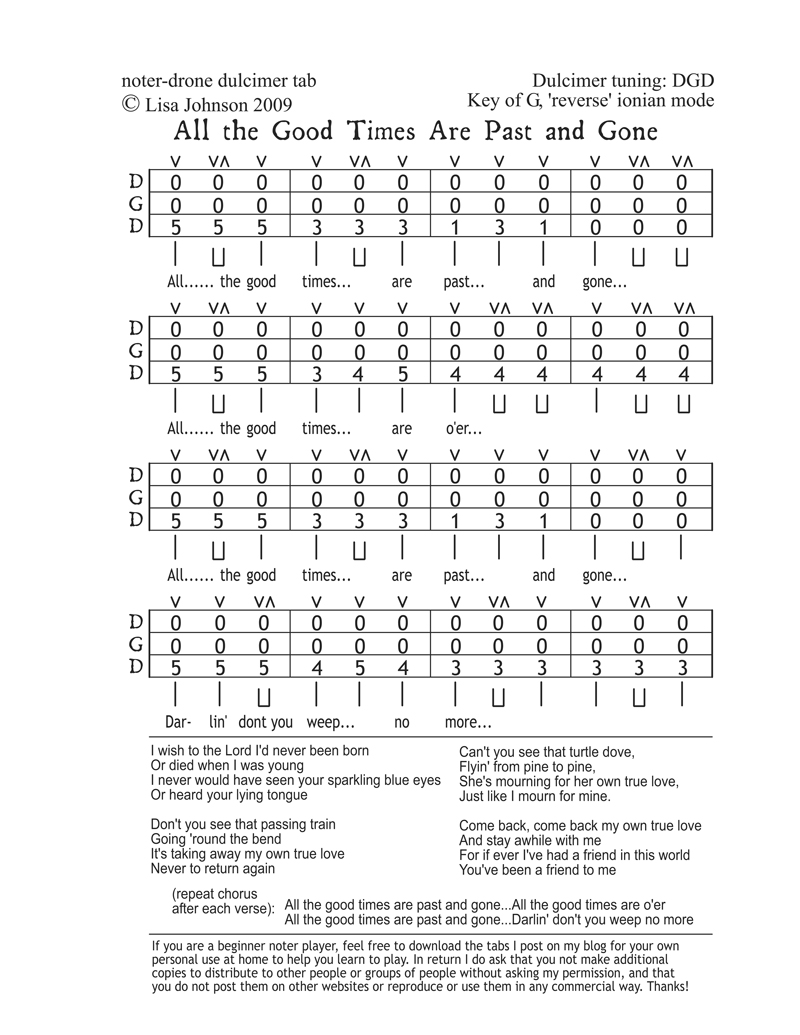
I know you probably are loathe to retune your dulcimer into the key of G from your 'comfort area' of being in D...but getting over the natural tendency to want to avoid re-tuning is going to allow you much greater freedom to play all kinds of songs and tunes later, and will give you the ability to play in fun jams of other music playing people... people who play in several different keys on other instruments. It's only hard and scary to change tunings the first few times you do it. After that it becomes much less of a big deal.

By the way- did you know the difference between a 'tune' and a 'song'? A tune is a piece of music usually with a melody, and a song is the same thing but with words/lyrics added to sing it. You sing a song, you play a tune. If you play a tune and then add words to it, it becomes a song!

"All the Good Times..." is a very good song to try to singing to while you play, since the first verse is pretty easy to memorize and sing on 'autopilot' while you play. Being able to sing a song while you play it is an immensely helpful skill to practice. It doesn't matter if you don't sing well at all, you can just sing by yourself all alone if you prefer. Having a slightly crude and rustic voice is actually something that's admired in old-time music! You'd sound pretty lame if you sang these old country songs in a trained operatic voice.
Practicing singing something simple while playing actually helps cement the song into your brain so that you can better play it without tab, and it helps you to keep rhythm better. Think of how easy it is to remember little children's songs from your youth- this is much the same thing. Plus, there may well come a time as you get to be a better player when you will actually want to sing songs with others, and if you practice this here and there during your early learning stages it won't be so hard to pick up the skill later.

As will all things, my advice is the same- start simple and slow, and don't get more complex until you feel comfortable. Remember this: it's far better to play 3 simple slow tunes well than to stumble awkwardly through 8 fancier tunes.
In this case, I'd suggest singing just the first few words with your dulcimer playing over and over: 'all the good times have past and gone'. Once you can play and sing that phrase comfortably, add the 'all the good times are o'er' to it. And so on. If you never get past the first verse, that's fine too!- at least you have shown yourself that you can do it.
Here is the song, in the key of G, ionian mode (but remember you can play the tab exactly the same way if you are tuned to D ionian tuning, DAA, as well):


continue reading the rest of this post here...