Saturday, March 14, 2009

scoundrels... The Butcher's Boy

Here is another old ballad in Aeolian mode... (Hey Ellemmbee!) I've put it in DAC key of D, and it's on the low side for singing- fine for me though. Remember, if you want to raise it a bit for your voice, try tuning up all strings one step to E aeolian: EBD. Don't tune higher than E or you may break a string unless you have a shorter dulcimer than the normal +/- 28" scale length.

This melody version of Butcher's Boy is a bit different from the usual versions. It's got a couple of quirky notes in it that I find appealing. I adapted it partially from Buell Kazee's recording of it in the Harry Smith Anthology. Notice that later in the ballad the villain becomes 'that railroad boy'...well this switching around of lyrics is common in older traditional folk music, feel free to switch it back to 'butcher's boy' if you want.
There are two extra lines of verse at the end, about the dove. If you repeat the last part of the melody you can sing them- start the dove lyrics right at the part in the tab where the first verse says "He courted me....". It'll sound like doing the ending twice at the end of the ballad. A pretty thing to do in a song, even without any singing.
And as always, you can always just play the ballads I post without singing them if you prefer. It's your music!

Girls, let this sad tale of woe be a warning to you...(to be safe, you'd better watch out for both butcher boys and railroad boys!)


continue reading the rest of this post here...

Friday, March 13, 2009

Lost at sea

I turned my back on my beautiful curly maple dulcimer for seven years, after having learned to play quite prettily in modern chording/flatpicking style. I had become disillusioned with it. During those seven years that my dulcimer gathered dust, I fell in love with the raw and archaic lure of drones... I finally became newly determined to re-learn to play my dulcimer in traditional noter/drone style. Having been very active during that interim in listening to older field recordings, playing old-time banjo, and singing Appalachian ballads, I was now familiar enough with this older music to finally have a real sense of direction for my dulcimer playing.

I searched out material to learn from. What I discovered is that yes, there was indeed some very good teaching material out there concerning drone style and traditional playing...but it was scattered all about, often comprising a page or two in this book, a small chapter in that book, an article, an isolated web page on dulcimer history, etc. Much of the more helpful material was in older books. There were not many comprehensive recordings to be had either- a handful of good ones from a handful of traditional players, but even those consisted of varied styles between players. And often on a CD there would be one or two traditionally played tracks buried in with a dozen modern playing style tracks. It was frustrating. It was a challenge to gather a cohesive body of information to learn from. I wound up skipping all around from place to place, trying to fill in the blanks- of which there were many. I picked up a tidbit here, a tidbit there. Sometimes the tidbits didn't fit together well, and I had to figure that out too.

In stark contrast to this, during my search I encountered a seemingly endless sea of learning material geared towards helping beginners learn to play in chording/DAD/capo/flatpick style, the playing style so popular for the past several decades.
I began to wonder how on Earth any musical beginner with less experience than I in gathering traditional music information could ever manage to get started in traditional dulcimer playing on their own.

As I sought information in first one place and then another, I slowly began to find my own path through the teaching material and information maze. I am certainly no expert, and I'm not a professional musician either...but somehow I've managed to steer my way along, kept afloat by my strong interest and admiration for the logic and beauty of the older simpler ways of the dulcimer. I've had to overcome some puzzling musical obstacles, and lately I've had a steadily growing sense that others might benefit from and enjoy hearing about some of what I have learned (and continue learning), and my experiences along the way. Thus, on Valentine's Day I started this blog. Instead of writing books, an online blog seemed to me a more logical and efficient open-ended vehicle for freely sharing what I can offer, and for me to learn from you as well.

We all have our own musical journey to travel, but if we can share a little of what we've found with others, then each of our unique journeys will be that much richer. I still have a lot to learn- there are so many gaps in what I know. I hope to continue learning from others for the rest of my life.

continue reading the rest of this post here...

Thursday, March 12, 2009

a dreadful wind and rain...

Let's play one of those great old spooky ballads from Appalachia. You know, the kind where someone kills someone, usually in a gruesome manner!

Wind and Rain, often called The Two Sisters, or Twa' Sisters, is a very old ballad from across the sea, from Britain, Scotland, or thereabouts. The oldest surviving printed example, a 'broadside', is from 1656, so it likely originated even before that... Over the generations it has evolved and branched out into many versions with many different verses and even several different melodies. Here I've chosen a simple but lovely version with only a few of the key verses included. You can search the web and find other traditional verses for it if you like and add them into the version you sing. That's one of the wonderful things about traditional songs and tunes- there are so many versions and you can feel free to play one you especially like. There is no official 'right' version and no one can tell you how to play your version. Make it your very own!

Now when you look at this tab you are going to gasp when you see the tuning: CGG.
Don't panic. This is SUPER EASY! CGG is merely DAA but tuning all the strings one step down (in the alphabet, C is one step before, or 'lower' than D). You are re-tuning from D ionian mode to C ionian mode.
Why am I doing this? For two good reasons:
One, when I sing it in the key of D the high part is a strain on my voice so bringing it down a step to C makes it way easier for me to sing. You too may find this useful when you sing with your dulcimer...and
Two, I'm trying to get you used to the idea of re-tuning to play in several different keys. You already play in D, and you've learned how to tune to play in G. Now you can tune to C just by tuning whatever D tuning you are in down one step on all strings. So now you can play in D, G, and C! This works for all modes, so if you happened to be in D mixolydian tuning DAD, to play in C mixolydian you'd just tune all strings down one step and you'd be in CGC. See, it's not that hard! Don't chicken out....try tuning down from DAA to CGG...it's thrilling when you see how easy it is!
(Note: this is one of those unusual folk songs that does not end on its tonic/key note, in this case C. Instead it ends on a spooky G. Don't let that throw you, it's still in C ionian.)

And so....a dreadful wind and rain.

continue reading the rest of this post here...

Wednesday, March 11, 2009

All the Good Times


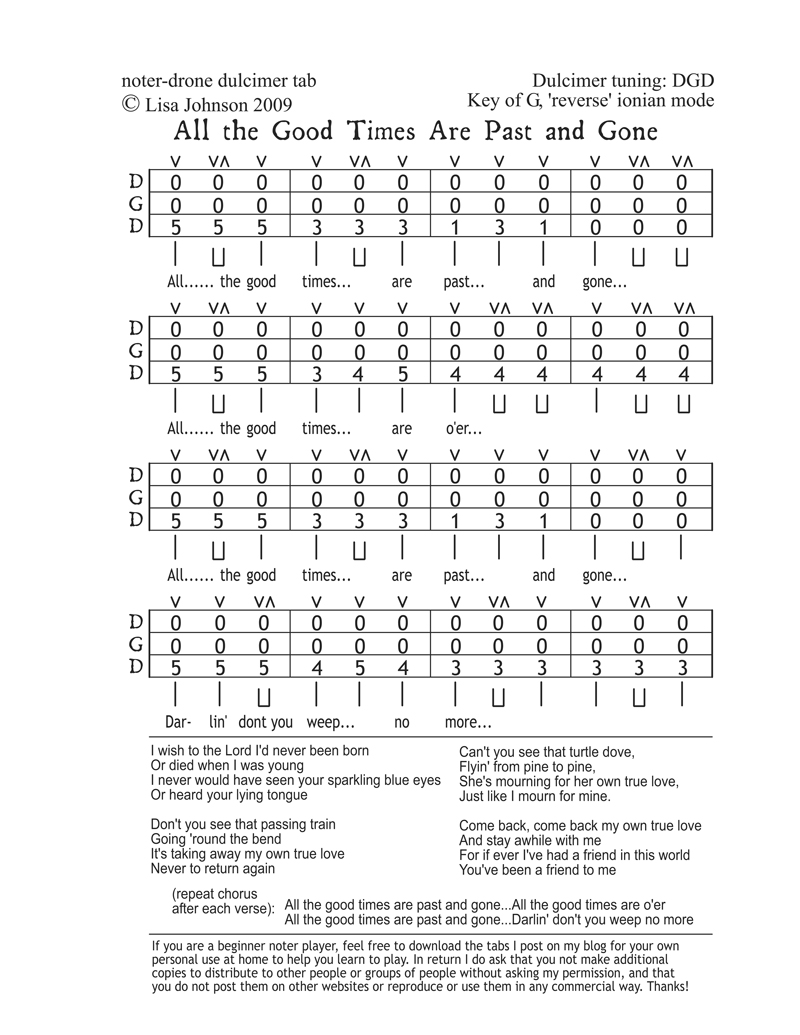
Here is a very nice simple traditional song- All the Good Times Are Past and Gone. It's especially good for beginners (are you with me, "papabill"?). I've presented it in the key of G, because that's the key I usually see it written out in. Also because you don't want to get stuck in the rut of only being able to play in the key of D... I've tabbed it for G 'reverse' ionian tuning (DGD). I presented a chart a few posts ago showing how to make the change from D 'regular' ionian into G 'reverse' ionian. Using the reverse ionian tuning sometimes can make the re-tuning process a little easier by changing the strings a bit less than going from regular D ionian to regular G ionian. I know that statement might be confusing- I am going to explain that a little further one day very soon. But do notice again that the song ends on fret 3, which gives us a hint that it's in ionian mode.
I know you probably are loathe to retune your dulcimer into the key of G from your 'comfort area' of being in D...but getting over the natural tendency to want to avoid re-tuning is going to allow you much greater freedom to play all kinds of songs and tunes later, and will give you the ability to play in fun jams of other music playing people... people who play in several different keys on other instruments. It's only hard and scary to change tunings the first few times you do it. After that it becomes much less of a big deal.

By the way- did you know the difference between a 'tune' and a 'song'? A tune is a piece of music usually with a melody, and a song is the same thing but with words/lyrics added to sing it. You sing a song, you play a tune. If you play a tune and then add words to it, it becomes a song!

"All the Good Times..." is a very good song to try to singing to while you play, since the first verse is pretty easy to memorize and sing on 'autopilot' while you play. Being able to sing a song while you play it is an immensely helpful skill to practice. It doesn't matter if you don't sing well at all, you can just sing by yourself all alone if you prefer. Having a slightly crude and rustic voice is actually something that's admired in old-time music! You'd sound pretty lame if you sang these old country songs in a trained operatic voice.
Practicing singing something simple while playing actually helps cement the song into your brain so that you can better play it without tab, and it helps you to keep rhythm better. Think of how easy it is to remember little children's songs from your youth- this is much the same thing. Plus, there may well come a time as you get to be a better player when you will actually want to sing songs with others, and if you practice this here and there during your early learning stages it won't be so hard to pick up the skill later.

As will all things, my advice is the same- start simple and slow, and don't get more complex until you feel comfortable. Remember this: it's far better to play 3 simple slow tunes well than to stumble awkwardly through 8 fancier tunes.
In this case, I'd suggest singing just the first few words with your dulcimer playing over and over: 'all the good times have past and gone'. Once you can play and sing that phrase comfortably, add the 'all the good times are o'er' to it. And so on. If you never get past the first verse, that's fine too!- at least you have shown yourself that you can do it.
Here is the song, in the key of G, ionian mode (but remember you can play the tab exactly the same way if you are tuned to D ionian tuning, DAA, as well):


continue reading the rest of this post here...

Tuesday, March 10, 2009

Why is it?

Ok, so why is it?....

...that when i was just starting out, played gently, and was so afraid of breaking a string, I would break strings about three times as often as I do now? I don't get that.

...that I never seem to be in right key when a playing session starts?- you'd think the odds would favor already being in the right key at least sometimes!...

...that I tend to bring my dulcimer to larger gatherings since I figure there'll be more than enough banjo players already there...but then every session has at least two loud banjos and I can't hear my dulcimer at all then and wish I had brought my banjo so I could at least hear what I'm playing?

...that as soon as I put my dulcimer away and take my banjo out, they start playing all my favorite dulcimer tunes? (and vice versa)

...that I seem to be able to remember how to play a fiddle tune ok, but can never remember it's name?

...that people seem to think that dulcimer players can only play in the key of D? (well actually we do know why, don't we?- but let's pretend we can't imagine why anyone would think such a thing!)

Wish I had time for a longer post, but I've been extra busy and now I'm too sleepy and just want to go to bed!


continue reading the rest of this post here...

Sunday, March 8, 2009

The beautiful aeolian mode

If you've been following along with this blog, you have already tried playing in two different modes: the mixolydian mode (such a DAD) where you tune so that the base/tonic note is located on the zero fret (open string)....and the ionian mode (such as DAA) where you tune so that the base/tonic note is found on the third fret.
Now I'd like to get you playing in the truly beautiful and haunting aeolian mode. The base/tonic note of the aeolian mode is found not on the open string or the third fret, but on the first fret. Remember how I said most songs end on their base note or tonic note? Notice that the tab below for Shady Grove in aeolian mode ends on the first fret then.
The aeolian mode has a minor sound to it, often mournful, sad, or spooky. It's probably my favorite mode. Many of the loveliest and oldest ballads of them all are in aeolian mode... Some modern guitar players don't quite know how to accompany aeolian mode tunes, and as a result they sometimes play non-modal-y minor chords to them that are close, but don't 'quite' match, and they wreck the delicately mysterious aeolian sound of special intervals and dissonance, instead making it sound rather peppy and cheerful. Ugh. Try this tuning on your dulcimer and see how very special and wonderful the aeolian mode is just by itself. I bet you'll get hooked on it like I did.

Here is a simple tuning chart to help you get into aeolian mode. It is in the key of D because you are probably already familiar with tuning and playing in DAD, key of D.To get into aeolian mode from DAD mixolydian mode, all you have to do is tune your melody string(s) DOWN one whole step from D to C.
To get into aeolian mode from DAA ionian mode, all you have to do is tune your melody string(s) UP two whole steps from A to C.
Your end result either way will be DAC. DAC is an aeolian tuning for the key of D.

If you are now in DAC aeolian mode, you can play Shady Grove, one of the most beloved old-time ballads from the hills of Appalachia where the dulcimer itself was born. Shady Grove has various versions of lyrics that have been passed down, and I have collected a few of my favorite traditional verses here for you to enjoy. See if you can sing a verse while you play. See if you can play it after a while without looking at the tab anymore.
The beauty of noter style playing is that it is less complicated than constant chord fingering, thus it is easier to learn to play a tune without reading the tab. This is worth repeating:
We are giving up 3-finger chording here in favor of using open drone strings- but to use drones effectively we have to be able to tune into 2 or 3 different modes. After the first little learning hump, it is a much simpler method of playing. Is it not a ballad that somehow touches the very soul in a lonesome way? I could play it for years and never get tired of it.

Now I'll point a few things of interest...
You may ask Why should I have to learn to play in different modes? Why can't I just play Shady Grove in DAD or DAA anyway? Well, if you try to play the same ballad Shady Grove in mixolydian DAD tuning or ionian DAA tuning, you will quickly discover that it's impossible- you are missing some of the frets you need to play the tune, as though it were a piano with some of the keys missing. This is what they mean when they say the dulcimer has a diatonic fretboard. It is missing certain notes on the fretboard and was intended to be played in open tuned modes. If the dulcimer had no missing frets, in other words if it had a fret for every note and every half note on the fretboard, then it would have a chromatic fretboard instead of a diatonic one. A piano is a chromatic instrument, so is a guitar. They have 'all' the notes. That's why you can play them so easily in all the different keys with minimal fussing.
Some people have additional frets installed on their dulcimers to enable playing in various keys and modes without re-tuning so much. The most famous additional fret to the diatonic dulcimer is the six and a half fret (and it's corresponding 13 1/2 fret one octave higher). Most mountain dulcimers made today do have the 6 1/2 fret, but before 1965 or so it was almost never seen. We'll look more at why it's so popular and how it's used later on in this blog.
Other people have a couple more frets added, such as a one and a half fret (and it's corresponding 8 1/2 fret one octave higher). I myself have dulcimers with these added frets. I'll discuss their use much later on as well. We can get along just fine without them, so don't get all worried. ;)
Going to the end extreme we have the fully chromatic dulcimer, with no missing frets at all. Some people like them, especially people who like to play more complex modern music on their dulcimers, such as blues, jazz, klezmer, etc.

Besides having extra frets, another way to avoid retuning to play in different modes is to use a capo. A capo is a little clamp that raises the string pitches across all the strings at once without re-tuning them. Capos can be convenient, and we'll discuss them in the future as well, but for now we are learning simple basic things and we don't really need to mess with capos yet. Besides, capos really change the sound of the dulcimer- making it less resonant and more 'shut' sounding, so let's enjoy learning to do things without capos for a while. I actually never use a capo, so don't get all worried about capos either. ;)

So far on this blog we have been playing only simple folk music that can be played on traditional diatonic fretted dulcimers having no extra frets. We've been playing only in three modes: mixolydian, ionian, and aeolian. We won't be complicating our lives with having to learn any more than just these three modes until quite a bit later in this blog!
We've learned that we can re-tune from D ionian down to G ionian for instance, and then play a song using the very same tab/fret numbers...because we are in the same mode, just a different key. Thus, we have begun to understand that we can re-tune to play in a key other than D while still playing in the same mode (more on that later on).

The good news is that ...you've already gotten past the most difficult part of playing your dulcimer in the traditional way! If you can re-tune your dulcimer into ionian, mixolydian, and aeolian modes, then you can play most common tunes easily on your melody string, and you will find there are more than enough beautiful and exciting traditional dulcimer tunes and songs played in these three modes to keep you thrilled and busy for a long time to come!

Although there are several other interesting and useful modes you could learn, just knowing these first three that we've tried so far is enough to cover most typical playing circumstances. The fourth mode that you'll probably discover you need eventually is the beautiful Dorian mode, but for now, using just these first three modes is fine. Another reassuring fact is that in old-time traditional music, you can usually get by just fine if you can play in only four keys: D, G, A, and C. And most old-time so-called "modal songs" or "minor songs" can probably be played in your aeolian mode tuning, if you can get into the key that's called for. Now, remember, if you find yourself in a jam with singer-songwriter guitar players with big egos who like to sing songs they wrote in keys like F sharp and E flat, then run like the wind. I tell you this for your own good. Just stay away from them and play your Shady Grove until it erases the strains of their whiny frou-frou songs from your brain.

Now, lest you start thinking I'm a stuffy old poop, I feel compelled to include here one of my favorite versions of Shady Grove....but it has almost nothing in common with the Aeolian beauty we are talking about in this post. But I still think it's darned cute! Here it is- Charlene Darling from the old Andy Griffith show, singing Shady Grove. Has anyone else ever been as impossibly perky as this??

continue reading the rest of this post here...

Saturday, March 7, 2009

Take your pick

Picks are a funny thing. One day you find what you think is the perfect pick, and then a few months later it just doesn't seem to be so great after all, and you suddenly find a different perfect pick. This simply means that the way we play is changing and evolving over time. This is a good thing, even though it means we may have to repeat our hunt for the right pick over and over. Funny how we seem to grow out of this ongoing search for perfection when it comes to searching for a mate...but not for a pick...


As I mentioned previously, when I started out playing the mountain dulcimer years ago I didn't really have any teachers and I wound up getting instruction books that taught flat-picking chord style playing, mostly in DAD mixolydian tuning. I first bought large thin flexible triangular picks made by Fender and Jean Schilling. I was strumming across all my strings and picking out melodies on the various strings as well. I kept breaking corners off these picks in my strumming enthusiasm, so I ordered a whole slew of them! Then I joined a dulcimer club where most of the tunes were played in that style as well. I quickly picked up on the fact that a lot of these people preferred much harder and smaller triangular Herdim picks with pointy corners. This seemed to be the way to go, and they were unbreakable, so I began to use them instead of my large thin triangles.
I found the small hard guitar-like Herdim pick to be practical for what we were doing- flatpicking melodies and chords on the various strings, often picking one string at a time and alternating quickly between strings. I remember it occurred to me at the time that we were all using flat picking patterns much like folk guitar players do, and indeed we were using similar picks as well. Bluegrass mandolin players also use such picks for picking out melodies over the various alternating strings. It just works well for this kind of playing. I played for about two years this way, and I became pretty good if I do say so myself.

That's when I discovered the banjo and my life changed.

My dulcimer hung on the wall unloved while I fell under the spell of the banjo's ancient untamed drones. I was tired of all the elaborate picking and chording I had been doing on the dulcimer. It had become ever more difficult to play without reading a complex tab 'code map' on a stand in front of me. It all suddenly seemed to me to be a fruitless march towards ever more tediously elaborate ornamentation. I wanted out.

I wanted to sweep the table clean of all the prettiness and instead connect with some mysterious raw inner resonance inside me. I imagined what it would be like to retreat to some mountaintop and blow on a grass reed, contemplating its single pure note for a few months. I abandoned my beautiful maple dulcimer and happily immersed myself in drones on my banjo for about seven years. I learned to play banjo with fiddlers who cross-tuned and played the drones I craved, I learned to sing old unaccompanied ballads and it was all wonderful and intoxicating. I became drunk on drones and archaic intervals.

As you may already know, eventually it occurred to me (duh) that I could play the dulcimer in a different way than I used to...in an older drone-based way that did not require flat picking melodies and fingering full chord changes across all the strings.
It was very hard for me to make this switch, but I was determined. I felt like a baby just learning to walk. I couldn't get the strumming rhythm right. I couldn't get the noter to work right or sound right. I was awful, and my misery lasted through weeks of trying. I truly hated sounding so awful and clumsy, but I kept at it. The key to my success was that I kept it simple. I played baby tunes like Go Tell Aunt Rhody and Hot Cross Buns. I didn't try to rush ahead of myself.
There came a day when I realized I was starting to enjoy sliding the noter up and down, my notes were beginning to ring clearer, and my rhythm had begun to improve. I asked my fiddler husband to play a simple fiddle tune (one that I could play well on banjo) and to play it v-e-r-y s-l-o-w-l-y so I could try to play along with him. It was really hard for him to play THAT slowly, but he did and was extremely patient with my musical fumblings. We played more, and I got better little by little. As the weeks went by, I became faster. Still not able to keep up with most old-time sessions, mind you, but faster than I was before. I discovered recordings of Galax style dulcimer playing, and this inspired me greatly! I too wanted to sound like 'a swarm of bees'...how incredibly exciting! They played so fast that their drones never stopped ringing! I too could fill the universe with my eternal/infernal drones!

The funny thing was that as I became faster, I found that my familiar little hard triangle guitar-ish pick was proving to be problematic for fast noter/drone strumming. It created a lot of resistance and held my speed back. Whenever it hit the strings it wanted to go flying across the room and resulted in my having to keep a tight grip on it. This would obviously cause hand cramping problems. But the problem with the hard little pick is that I didn't like the sound it was producing. It sounded too harsh, too loud, and too guitar-like... not delicately graceful like Jean Ritchie and her goose feather quill, and not bee-ish like the Galax players with their long flexible quill 'dominatrix eggwhippers'. Clearly I had to ditch the little guitar pick and go longer and more flexible.

Being a fan of things old-fashioned and traditional, I attempted to use a turkey feather. I had a bunch of them to experiment on. I tried preparing them in various ways I had read about, and I tried using each end in the prescribed way. What I found was that for me, they were not up to any sustained usage, and they tended to shred rapidly. This was frustrating. I had read about the resourcefulness of early dulcimer players, and about how they often experimented with various "plectrum" (pick) materials...bundled electrical wires, collar stays, leather, felt, wood, bone...they tried whatever they found at hand around them. I tried some of these materials as well (hmmm...not easy to find collar stays these days) and I came to the conclusion that maybe plastic would be most like feather quill material, yet perhaps more flexible and more durable than quills. I had read where others had used cut up credit cards as picks, for example. Not a very picturesque solution, but certainly practical! And thrifty, in more ways than one.

I began to experiment with cutting my own picks from plastic items. Credit cards were first. I found them way too hard. My old stash of thin flexible triangle picks was dug up and tried, but again they kept breaking. I tried heavy felt and leather, but the sound was too muffled for my liking. I tried bundling various wires together, but it sounded to fuzzy. I finally got hold of a collar stay, but it was too flexible and limp, as were some plastic tops from supermarket deli containers.

I was beginning to feel like Goldilocks.
I tried cutting up plastic milk jugs, that was getting closer, as were yogurt containers.
In the end, I found that using a small range of different plastic materials was just fine. I could use a slightly heavier one in a big jam situation and be heard a bit better, and I could use a thinner one when in a singing jam so that my strumming wouldn't drown out anyone's voice (including my own). Effects could also be varied according to how long/narrow/wide/pointy/rounded I cut them. Hey, this was fun!
Again I had to try to fight my tendency to become too fixated on the idea of finding the elusive Holy Grail perfect pick. The important thing for me was that I realized that longer more flexible picks were what I needed to get the sound I wanted for myself. You will seek the sound that pleases you.
Don't be afraid to have fun and experiment with making your own picks from interesting materials. You just might like the resulting sound better than the sound you have been getting from the pick you've been used to for a long time. Or not. But it's fun to cut up credit cards anyway.

continue reading the rest of this post here...

Friday, March 6, 2009

Picky, picky, picky

Every time I have started playing any new kind of instrument, I seem to go through the same evolution. During my first learning stages, every detail concerning the 'trappings' of playing had to be just a certain way if I was to play...

I recall feeling I had to have exactly a certain height of foot rest in order to play the mandolin... Any tiny variation in height was disastrous! Exactly a certain hardness of pick. With the banjo, I had to have perfect finger picks precisely molded to my fingertips in hot water, or else carefully applied fake fingernails filed just a certain way.
In my early dulcimer days, again I had to have exactly a certain type pick, a certain kind of strap, my music stand set at a particular angle, only certain strings, the right kind of chair...or else I just couldn't play well at all!

With all these instruments, after I had been playing any of them for a couple of years or more, these excessive details simply began to not matter to me so much. I became less obsessed with detail and more adaptable. I made do, and tried to not pander to my obsessive compulsions. I like to think that my fussiness was getting on my own nerves. Laziness played its part as well- I might be sitting at my desk in my office at home and suddenly want to check on a note in some tune, so I'd grab my dulcimer from the wall here and pick out the tune without bothering to go get a pick or a noter and even without bothering to get out of my office chair with its aggressively anti-musician arms. {{{shudder}}}

In my previous post about noters, I told the story of losing my 'special' green noter and how I enlisted the help of others to desperately search for it in the grass for what seemed an eternity. (note to self: Don't use your green noter when playing outdoors in the grass)
It's a good example of how something as simple as a little stick can take on way too much importance if you let it.

Having become aware of this tendency in myself to obsess about the superficial trappings associated with playing an instrument, I now make a game of it. When I suspect that I am becoming too dependent upon some accessory or brand of something, I now purposely remove it or use something else for a while.

I have come to see this restrictively dependent behavior as a barrier between myself and my music. All it does is create a slew of imaginary reasons why I might think I don't sound good or play well. I am not a professional musician, nor is it my goal to become one. So in the end, it's not how well I play or how 'good' I sound that is most important to me- rather it's the joy and pleasure that playing music brings to me and to others who might enjoy playing with me or listening. The one most important truth I have come to feel about music is that joy overrules perfection.


And speaking of being picky...I want to discuss picks in my next post!

continue reading the rest of this post here...

Thursday, March 5, 2009

Four Marys

Sometimes I am in the mood for writing about how I feel about music, sometimes I like to write about playing techniques, and sometimes I like to work out a song on my dulcimer and share it with others.
I felt like playing instead of writing this evening, so I hope you don't mind that I just post this version of Four Marys (also called Mary Hamilton) that I worked out on paper today... It's a wonderful very old ballad that has been around for generations. Jean Ritchie's family used to sing it as well, in fact here is a Youtube clip of Jean and her sister Edna singing it unaccompanied: Jean and Edna Ritchie singing Four Marys. As with most old ballads, there are many versions to be found.
Here is some interesting background on the ballad: Four Marys/Mary Hamilton
I transcribed it into the key of D, ionian tuning (DAA), for no particular reason. You could easily re-tune to C, G, or A (if that's better for your voice range) and play it in those keys as well, even using the same tab numbering if you make sure to remain in the ionian mode when you re-tune. I love the words to this ballad...so tragic and sad! I hope you enjoy it.

continue reading the rest of this post here...

Wednesday, March 4, 2009

Devolving doors

I seem to be slowly 'devolving' in how I derive joy from music as I get older. I don't know why.
When I was a schoolgirl, I played the 'cello in the school orchestra for about 6 years. I liked that I was playing music, but even back then I felt that much of the music we had to play sounded awfully fussy. All those movie theme medleys, Sousa marches stomping about, storm-at-sea symphonic excesses of every kind. It sounded to me like an endless series of fever pitch crescendos all strung together, and it made me tired. No one else seemed to feel that way. I thought maybe I was just odd...

I went through the usual teenage fervor of rock music, dutifully worshiping Jimi Hendrix, Jefferson Airplane, The Doors, The Stones, Joplin, etc. I think it was likely induced by raging hormone levels though.

Once in my twenties I settled back into gravitating towards vintage music. I explored many genres of music in my 20's and 30's, listening fiercely and absorbing subconscious things about music along the way that I would not be clearly aware of, even now. Medieval and Renaissance music, Indian ragas, Cajun, Chinese erhu, Japanese koto, Indonesian gamelan music, Puerto Rican folk music, Western Swing, Bluegrass, French and Tejano accordion, Carter Family, Gregorian chants, Buddhist chanting, bamboo flute, blues harmonica, Appalachian ballads.... they all whispered to me in tongues that I couldn't understand, but was strongly attracted to. On overload, my mind shifted into neutral and my ears took over, filtering the vast amounts of incoming listening data into some mysterious filing system of their own invention deep in my psyche somewhere. Most of this exploratory journey was unplanned and unorganized.
The one pattern I began to notice after about 20 years of this active listening, was that I seemed to be attracted strongly to the very oldest examples of each genre I became fond of. This told me something. As each genre advanced and evolved in it's own time line of existence, it became generally more elaborate as music- with more notes, more complex structure, more backup instrumentation, more chords, added instruments. My preference predictably drifted towards the simpler non-adorned earlier examples to be had. This trend continued on to my musical tastes today.

After playing several different instruments over the years (none very well), for the past 12 years or so I have settled upon the mountain dulcimer and the clawhammer/frailing style banjo as my two vehicles of musical expression. Interestingly, both these instruments make heavy use of open drone strings and open tunings. Though I didn't particularly plan it that way, it seems likely that this was no accident.

The drones are a profound attraction for me- they touch my very soul when I hear them, and if I play them myself, well all the better when they resonate through my bones! I then become the music in effect- my body literally becomes a resonating chamber, part of the whole instrument. There is something so primal and archaic about drones and old note intervals (my favorite pair being the 1-5 interval). I love that drones and intervals leave space for the soul to float in. They do not quite fill in the whole story of the tune for you like modern 1-3-5 chorded structure does so tidily. Instead, your spirit can float within the notes and drones and make it reflect your own mood- sad, happy, spooky, peaceful... each person can move and breathe within the music in their own expressive way, as though they were dancing freely in an empty room.

The very simplicity and openness of this traditional music structure is what sets me free. It sets me free from having to feel and hear and play a certain way, free from the stresses in my day, free from frustrations and limitations. I can move within the loosely woven melody and drones as I please, and take from them what I like or need, leave the rest a mystery. Simple traditional music both gives and forgives. It doesn't even ask to be played 'well'...it just asks to be played, nothing more. It is like a perfect love.

continue reading the rest of this post here...

Monday, March 2, 2009

Get Out of Jail Free

You now know how to re-tune your dulcimer in order to play Liza Jane in either mixolydian mode or ionian mode in the key of D. Next we will re-tune to do the very same thing but in the key of G!... Here are two charts I made up so you can visualize how to re-tune into G ionian and G mixolydian. (remember just click on it to enlarge it)

The first chart shows how to re-tune from regular D ionian and D mixolydian (DAA and DAD) into regular G ionian and G mixolydian (GDD and GDG). Tune DOWN three steps from any D notes to G notes, and tune UP one step from any G notes to A notes.Keep in mind that on a typical dulcimer, you cannot tune your high strings higher than about a high E note without being in danger of them breaking with the tension. Thus, if your melody strings are already tuned to DD and you see in the chart that you need to change them to GG, then you have to tune them DOWN to GG, not up! That also means that when re-tuning the A middle string to a G, you should tune the A string DOWN one whole step to G. (remember: the musical scale goes up like abcdefgabcdefgabcd...etc, so G is the note below A)

The second chart shows another way to get into G which is a bit unconventional but which means you will be re-tuning your strings less and for shorter distances. This method is to use what is called a "reverse tuning". Most tunings have your bass string match the note of key you are in, and the middle string is a fifth higher than that- hence D ionian is DAA. (from D to A is five steps up in the alphabet- a fifth) In 'reverse' tuning, you switch the bass string to be the fifth, and the middle string becomes the key/tonic note. D 'reverse ionian' tuning would then be ADA instead of DAA. (the last letter of the three usually meaning the melody string(s). The reverse tuning does change the sound a bit if you are playing with a heavier bass string (as opposed to Galax style where all strings are the same gauge and same octave), but it might be a little easier to go from D to G and vice versa.
Here is the chart to go from regular D ionian and D mixolydian (DAA and DAD) into G reverse ionian and G reverse mixolydian (DGD and DGG):
If this whole business about reverse tunings is too confusing to you, then just use the first chart to change between regular D and G tunings. Come back to this later on and you might understand it better then. It's really very useful and worth understanding at some point (especially if you prefer your strings to be all the same gauge and tuned in the same octave).

The point of all this re-tuning is- when for instance you tune from D ionian to G ionian, you are in a different key, but still in the same MODE, which means your tune will still be home-based on the same place on the fretboard and your tonic/key note will still be on the third fret. What does this mean to you? It means you can then play Liza Jane in EXACTLY the same way in either D ionian or G ionian, on the same frets. You can even use the same tab as the one below in D ionian! The fret/tab numbers will remain the same, but you will actually be playing in the key of G rather than the key of D. This is very handy to be able to do. If you learn to play several songs in the key of D in mixolydian mode, why then, you can just re-tune a couple of strings quickly and play the song exactly the same way but in the key of G! Imagine how much this will open up playing situations for you if you get the chance to play with friends in folk jams and old-time groups.
No longer will everone roll their eyes when you mumble that you can only play in the key of D. Now, you can play your favorites tunes in either the keys of D or G, and in two different modes!

If you have come this far with me, then you have gotten through what I feel is the most 'brainy' part of playing music on your dulcimer- understanding the basic concept of modes on your dulcimer, and re-tuning to change modes and keys. Getting over this first hump of understanding why we might want to re-tune is a major victory- it frees us from the DAD 'prison' that so many new dulcimers players find themselves in today. In many ways, it gets easier from now on. So relax and congratulate yourself! Practice playing the tunes you already know and practice re-tuning to play them in the two different modes and two different keys we've been using so far. And if you break a string once every couple of months or so because you re-tune frequently, that is actually pretty normal ...so what?- guitar and banjo players break strings all the time! Never breaking strings to me is a sign of a timid player who's stuck in a rut. Be proud, have fun!
We'll slowly learn more about playing in different keys, using capos, playing 'spooky' murder songs in the very beautiful aeolian mode.... but next post I want to discuss some of my own quirky little playing preferences that I have come to after playing for a while.


continue reading the rest of this post here...

Sunday, March 1, 2009

Liza Jane does ionian


So you know how to play Liza Jane in DAD mixolydian tuning.
Now here is the exact same song Liza Jane but in ionian tuning, DAA...Both the DAD version and the DAA version are playing the very same notes, just in two different places on the fretboard when the melody string is tuned differently. When the melody string is tuned down lower, you have to go a little higher up on the fretboard to play the same notes.

It's really good to know how to convert a song or tune into a different mode this way. Why, you might ask? Because one day you will hear a simple song you love and you'll want to try to play it on your dulcimer...but perhaps when you start playing it you may find that some of the frets you need for the song are missing. Horrors! It's that pesky diatonic fretboard again!
Well, if you know how to retune a bit to change the mode, then your song will move its 'home base' to a different place on your fretboard where you may well have all the frets needed to play the song. Once you find where the song 'lies well' on your fretboard, you can make a note of the tuning best for that song.

Both ionian and mixolydian modes are often used and it's very practical to know how to play in both modes.

But wait! If you are thinking both these modes are only for playing in the key of D, you're wrong! That's what makes them so very handy- you can play tunes inother keys as well, and still decide whether mixolydian or ionian mode works better for any particular tune. More on that coming up.

continue reading the rest of this post here...

Saturday, February 28, 2009

Liza Jane looks good to me

As I said in my previous post, being able to play a tune in more than one tuning or mode, and in more than one key, is a great thing to be able to do if you want to be able to play with others, especially if they are playing other instruments like fiddles, banjos, or guitars. Old-time tunes are not usually complicated and this fact, combined with the simplicity of a noter/drone style simple melody line, makes it not that hard to learn how to do... if you are willing to experiment just a bit. It's one of those things that sounds harder to do than it really is...

Remember how we saw that you can often play a tune equally well in DAA as in DAD tuning? Remember that DAD is mixolydian mode and is based around the open string (the 'zero' fret). And DAA is ionian mode, based around the third fret.

Here is a tuning chart for the mixolydian mode, key of D:
Tune your dulcimer to DAD and try to get comfortable playing the old-time favorite Liza Jane as noted in the tab below. Notice the strumming pattern changes slightly in different places- we don't want to strum the exact same way all the time, that would be tedious to listen to.
Play Liza Jane a lot and see if you can play it without needing to look at the tab anymore. Tab is just a way to figure out how a tune goes when you forget it or haven't tried it yet. When you are in a restaurant, you look at the menu to help you decide what to order, but when the food arrives it's time to put away the menu and enjoy eating!
Next post we'll switch to playing the very same Liza Jane in ionian DAA tuning. Maybe you can already figure out how to do this on your own? (Hint: remember that the melody lies three steps higher up on your fretboard in ionian mode.)


continue reading the rest of this post here...

Friday, February 27, 2009

DAD and DAA can often play together

Have you ever gone to a dulcimer session where everyone is tuned to DAD and you've gotten into a panic because you are in DAA and you think you have to retune in order to play with them? Well never fear! If the DAD'ers are playing a tune that uses the 6 1/2 fret, you can play right along with them even though you are in two different tunings. This is because if they are using their 6 1/2 fret, they are really playing in ionian mode, so you are both playing in the key of D in ionian mode. Your D scale tonic note simply starts on the third fret while theirs starts on the open string. Often you can both play the exact same melody notes, side by side, just on different frets...
Take Mary had a Little Lamb as an example. In DAD tuning, you would play it on these frets:
2-1-0-1/2-2-2/1-1-1/2-4-4
2-1-0-1/2-2-2-2/1-1-2-1/0....

You would play the exact same notes and sound exactly the same in ionian DAA tuning by simply playing it on these frets instead, 3 steps higher on the fingerboard, but you'd get very same sounding notes:
5-4-3-4/5-5-5/4-4-4/5-7-7
5-4-3-4/5-5-5-5/4-4-5-4/3....

Also, you can play your noter style Mary Had a Little Lamb right along with the other people's chord style version. Usually they will work just fine together, as long as you can hear yourself and don't get distracted by all the extra chord notes going on around you.

NOTE: If others are playing a tune in DAD and using their 6th fret rather than their 6 1/2 fret, then they truly are playing in mixolydian mode. The tune Old Joe Clark would be a good example. In this case you cannot play along with them in DAA ionian, because you are then both in different modes and you cannot play Old Joe Clark along with them in ionian...you will be missing some notes. But there are many more ionian folk songs than mixolydian ones, so interestingly enough, 'most' of the time you will find DAD players using their 6 1/2 fret and playing in ionian mode even though they are in a mixolydian tuning. They would not be able to do that without their extra 6.5 fret, by the way.

When you change your tuning from DAD to DAA, you are tuning your melody string DOWN three steps from D to A. That means in order to play the same thing the DAD player is playing, you have to move your song UP the fretboard by three steps/frets to adjust for your lowered string. DAD mixolydian tuning songs are home-based around the open string (written as the 'zero' fret in TAB), while DAA ionian tuning songs are home-based around the third fret.

The point I am making is that modes are nothing terribly mysterious. Practically speaking, they just mean you are starting your song on a different place on your fretboard.
And because the dulcimer is diatonically fretted (meaning it is missing some frets in certain places), you might be better able to play some songs in one place on your fretboard, and other songs in another place, in order to be able to get the notes you need for that tune without 'missing' any notes because of a missing fret. So you change modes or tunings to find a good place for that song to lie, where you can get all the notes that song needs.
This works particularly well in noter/drone traditional playing style.

Next post, I will present a simple key of D, DAD noter tab and words to a really fun old-time song that many of you may know already- Liza Jane! Then we'll see how we can play the same thing in DAA ionian mode. Then after that, maybe we'll figure out how to play it in the key of G. Without a capo. (!)
Once you understand how to do this (and it's not that hard if you take it one simple step at a time), you'll be on your way to playing along in most keys in typical old-time music jams.

continue reading the rest of this post here...

Thursday, February 26, 2009

Grace

The mountain dulcimer is an instrument full of grace in every way. It soothes the soul and makes the heart glad. Doesn't matter how fast or how slow you play, how fancy or how simple you play. This is part of the dulcimer's ageless beauty- it is both willing and able to express anyone's inner music, young or old, absolute beginner or experienced musician. It lends its grace to every person's music...
Here is a very simplified tab for beginners to play the beloved and inspiring hymn Amazing Grace. Click on the picture to enlarge it. This version is in DAA in the key of D. Play it often and feel its beauty:

Once you are comfortable with playing it, try to learn to play it without looking at the paper- just work on one line at a time, it's really not that hard once you've played it many times. Most of you know the hymn already in your head. For beginners, it's often easier to learn a single simple melody line without peeking than to remember chord fingerings. The drones will make it sound heavenly without any fancy playing at all!
You will be proud when you can play it by ear and make it your very own!

continue reading the rest of this post here...

Wednesday, February 25, 2009

What happened?

Ron left a comment after my last post in which he said:
"I want to enjoy the dulcimer, not make it a project or an ordeal...No one told me that if I want to learn dulcimer, there were two ways to go---chording or melody/drone."

This got me to thinking...What has happened in the past several decades to so completely change the way beginners are introduced to the Appalachian dulcimer, to the point where many beginner dulcimer players aren't even told about the existence of traditional melody/drone style playing anymore? How did these changes happen, and what is the result? I fear this will take more than one post for me to ponder...

Let's start with some of the verified facts we do have about how the dulcimer used to be played long ago in Appalachia. One reliable source for this information is Jean Ritchie, who has written a great deal about her family, neighbors, and music players near her childhood home of Viper, Kentucky. Much of Jean's information comes from both before and after the 1920's when she was born.
We know that Jean's father Balis Ritchie (born 1869) used to play his dulcimer in melody/drone style, without playing full chords, and that according to Jean he only played in one tuning: CGG, which is the ionian tuning for the key of C. This is identical to our DAA tuning for the key of D, but tuned one whole step down on all strings, to play in the key of C instead. Many early church hymns and simple older folk tunes were played in the key of C in the old days.
Jean grew up in a time when people in the mountains were beginning to listen to the radio, and when she was a young lady she said that many of her friends scorned the 'old' music that their parents played in favor of more modern dance music and swing that was on the radio during the 30's and 40's. Jean experimented with different dulcimer tunings and with playing harmonies to compliment her singing. By the late 1940's the folk music boom was beginning, and Jean went to NYC with her dulcimer and her mountain repertoire and became a hit with the burgeoning folk scene there. Guitar playing folk musicians were everywhere, and they accompanied most songs with full sounding guitar chords.
Most of us have grown up deeply influenced by this folk boom era of the 1940's-60's, and we all grew up hearing our popular music framed in neat and resolved chord structures. Non-chordal 'archaic' drone based music was heard less and less. When it was heard, the usual reaction was that it was lacking something, or that it would sound more complete and thus better with a guitar chording backup.
This appetite for full chord structure spilled over into the dulcimer of course, and by the 1960's-1980's, a whole new generation of young urban dulcimer players were busy building dulcimers and exploring new frontiers of playing modern music on the dulcimer. This did a lot to popularize the dulcimer beyond even what Jean Ritchie might have imagined. But these talented young folk players overwhelmingly liked their music accompanied by standard Western chords, and chord playing/flatpicking guitar-like style was what most people could relate to- especially people who did not grow up hearing an older generation's traditional Appalachian music sounds. The addition of the 6 1/2 fret made this transition to chords even easier, as it enabled people to play in ionian mode while in mixolydian DAD tuning.

Thus it was that between about 1945 and today (over sixty years later) there has been a steady movement away from the more archaic interval and drone based music, and towards modern Western chord-based music. One could say that this is neither 'good' nor 'bad'....it just is.

Looking at dulcimer insruction books, one can clearly see this trend in action. Books written in the 1960's and 70's (starting with some of Jean Ritchie's instructional materials), will often be structured around the key of C, in ionian tuning (CGG or DAA) and playing noter style- or at least presenting the first chapters in learning/explaining the dulcimer in noter style, even explaining how to tune to the different modes. Some had their songs written out in standard music notation, with a single melody line. Later books begin to emphasize the key of D instead of C, the mixolydian tuning of DAD, and encourage the use of chords over the 'limited' use of a noter, and they often encourage the use of capos and the addition of added frets to change keys as opposed to re-tuning. If the book did contain a chapter about modes and other tunings, the reader would likely skip over that part as being too full of complex and unnecessary 'music theory'. Stuff for eggheads or music scholars. Chording the diatonically fretted dulcimer while playing the melody too was hard enough as it was without having to learn various new sets of chords for different tunings and keys!
The generation that learned dulcimer from these later books of course became the new teachers, and they began to teach DAD chording style to the legions of beginner players attending the new popular music camps, festivals, and workshops, and buying CD's, teaching DVD's and more books.

The end result of all this is that the beginner dulcimer player of today is typically presented with learning material that focuses heavily on chording/flatpicking style of playing, in the key of D and tuned DAD. The occasional switch to DAA or the idea of tuning to another key or mode is now seen by beginners as being scary and difficult- something to be avoided if at all possible.
Instead of learning only a simple melody line and letting the drones flesh out the sound, students must now keep giant binders full of tabbed chords in front of them at all times. The older beginner especially, with limited musical experience, may find the many chord fingerings to be daunting and complex and he/she winds up having to juggle flat picking on various strings, stretching fingers into difficult-to-reach chord formations that change quickly, and keeping track of the tabbed chord fingering numbers on the page...all at the same time. Yikes!
More about simple playing in my next post.


continue reading the rest of this post here...

Tuesday, February 24, 2009

DAA in birdland- Hush Little Baby

Here is a simple diagram I made up to show the ionian mode DAA tuning for playing in the key of D:(If you click on the images on this blog, the images will show up larger and clearer on their own page.) The "do" note of a do-re-mi-fa-sol-la-ti-do scale would begin on the third fret. Most simple folk songs in the key of D will END on a D note, at the third fret... (Some D songs will also begin on that D note, but many do not begin on the tonic note, so it's more reliable to go by the note the song ends on.)

Here is a nice folk song to play in the key of D in ionian tuning DAA...Hush Little Baby: Notice how in this song you will play the open string a couple of times- which is 3 steps lower than the tonic note D on the third fret. This is a perfect example of where DAA ionian mode tuning is more practical for noter/drone players than the common DAD mixolydian mode tuning. Notice also how like most simple folk tunes, it ends on the tonic note- in this case the D on the third fret. Hush Little Baby is one of my favorite songs to sing and play on either dulcimer or banjo. I just love the story in it's words.


continue reading the rest of this post here...

Monday, February 23, 2009

Changing tuning from DAD to DAA

First I recommend you read yesterday's blog post about why I like DAA tuning. Now, if you are in the common DAD tuning already and you want to try DAA, just tune your two melody strings DOWN to match the same A note that your middle string is. This might feel like less tight tension on those strings as you play, but it should still play fine on any normal sized dulcimer.

If you have any TAB that is written for DAD noter style playing, you can 'translate' that TAB into DAA tuning simply by increasing each fret number on the paper by three... In other words, a DAD noter style tab which is written 0-1-3, will become 3-4-6 in DAA tuning. If you have a favorite tune in tab notation, this is a good way to figure out how to play it in a different mode.
Modes need not be some complex and mysterious theory puzzle....Instead, just think of modes as having the starting note "Do" of your do-re-mi scale start in a couple of different places on your fretboard instead of always on the open melody string. Doing this is pretty easy if you are only making fretted notes up and down the melody string, as in noter/drone style playing. People who play dulcimer in chord style have to learn a whole new bunch of chord fingerings for each mode or tuning- no wonder they hesitate to try out different modes! We noter players have it easy when trying out various tunings.
On this blog, I am mostly going to stick to only two modes anyway for a good long while- starting with ionian (like DAA). Later on I will go into the haunting and lonely sounding aeolian mode (DAc). There are enough beautiful and delightful songs in ionian and aeolian modes to keep anyone busy for many years of thrilling and deeply satisfying playing!

Modes are not hard to play in at all, and you don't need to learn everything about them, far from it- only a few key things that are useful. In fact, modes actually make things easier for us to play on our dulcimers! More about this later on. For now, don't worry, just try the DAA (ionian mode) tuning.

continue reading the rest of this post here...

Sunday, February 22, 2009

Why I like DAA tuning so much

These days, the majority of beginner dulcimer students are started out playing in the DAd tuning. This is the mixolydian mode. That means that if you are playing in the key of D, the beginning D note of the do-re-mi scale is at the OPEN melody string, which is tuned to the D note. In the key of D, that first "do" note of the do-re-mi scale is a D.
These days, we name the strings of a dulcimer tuning from bass string first to melody string last. If I were to say a tuning of DAd, then that last d is the melody string (the string or pair of strings which is closest to you with the dulcimer in your lap). So, if you tune your dulcimer strings DAd (or DAdd), then the first note of your D scale on the melody string will be the open string- or "0" (zero) in dulcimer TAB notation. In the key of D that first D note is also called the tonic note.

Most songs and tunes end on their tonic note. For example a song in the key of C will usually end on a C note (the tonic note for the key of C). But many tunes have notes in them somewhere that go a step or two below the tonic note... For example, sing the song Frere Jacques to yourself. The last line ends in "Ding, dong, ding". The song ends on the tonic note on that last "ding"....but the "dong" right before it is three steps below the tonic note. If the key was D and the tonic note was a D, then that "dong" lower note would be an A note 3 steps lower. Many traditional folk tunes and many fiddle tunes or old ballads that I like to play have these lower notes in them that are 1, 2, or 3 steps lower than the tonic note.
Now if your melody string is tuned so that it plays the tonic note when it is open (as in DAd tuning), well then that string can't play any notes lower than that tonic note. Thus you would have to go looking on your lower middle or bass strings to find those lower notes. People who play dulcimers in a chording style are used to fretting lower notes on the other strings. So to them, DAd is a perfect tuning which enables easily fingered full chords on all the strings. Lower-than-tonic notes do not present a problem to folks playing in chording style and fretting all the strings.

In typical noter/drone playing, however, the middle and bass strings are not usually fretted at all as part of the melody line, but are simply left open to drone. This droning gives the music an archaic sound that is distinctive and appealing to those who enjoy noter/drone playing. So where would we go to play those occasional notes that dip below the tonic note?

Well, if we tune our melody string(s) a little lower to begin with we can get those lower notes right on the melody string, like that "dong" note in Frere Jacques!

Thus, when I want to play in the key of D, I most typically tune either DDA or DAA, tuning my open melody string(s) to the A note which is 3 steps below the tonic D. This is not the mixolydian mode anymore. If your tonic D note is on the third fret now instead of the open string, then we now are in the ionian mode. :)

Here is another example of how handy this becomes-
Sing the first line of the song "I've been workin' on the railroad". The first and last notes ("I've" and "road") are the tonic note, and the "been" is a note 3 steps lower than that. If I was tuned DAA then, I could play all those notes right on the melody string, and in TAB the fret numbers for "I've been workin' on the railroad" would be: 3.../0/3/0/3/4/5.../3...
I hope this helps explain why I like tuning this way!

If we tune the melody string so the open string is the tonic note, it is in mixolydian mode. If we tune the melody string so the third fret is the tonic note, it is in ionian mode.
Another example... let's keep in mind that in music, notes go up the alphabet until the letter G, and then they start repeating from A again, but in the next higher octave, like abcdefg-abcdefg-abcd....etc. So if I were playing in the key of A and my open melody string was tuned to A, then I'd be in mixolydian mode. If I lowered that melody string to be three steps lower than A (and look at my alphabet layout above), I'd tune it down to the E that was lower than the tonic A. Then my tonic A note would be found on the third fret instead of the open string, and again I'd be in the ionian mode, but in the key of A this time, and again being in ionian mode would enable me to play some of those lower notes on my melody string.

So far, the TABS I have posted have been in the key of D, and in ionian mode. The tuning is DAA, with the last A corresponding to your melody string.
If you have any confusions about this so far, please do post a comment or question and I will get back to you on it and try to explain better.

continue reading the rest of this post here...

Friday, February 20, 2009

Dulcimer Land / Aunt Rhody

My new student phoned me today to tell me that she could not stop playing. She said her children were upset because she didn't even make dinner for them last night. (!) She said they would come up to her while she was obsessively strumming Hot Cross Buns and say things like "Mom, I know you're in 'Dulcimer Land' right now, but...."

Dulcimer Land is a nice place to be.
She told me she must have her very own dulcimer, and it must be as soon as possible.

Here is the second song she has been working on. I made a simple tab sheet to help her at home...Go Tell Aunt Rhody:
If you are a beginner noter player, feel free to download the tabs I post on my blog for your own personal use at home to help you learn to play. In return I do ask that you not make additional copies to distribute to other people or groups of people without asking my permission, and that you do not post them on other websites or reproduce or use them in any commercial way. Thanks!


I find it amazingly timely that this new student came to me for lessons just a few days after I started this blog. And because she had absolutely no experience whatsoever with making music prior to this, I think she will help me discuss how beginners can get started playing that beautiful instrument we call the Appalachian dulcimer.

In my coming posts I want to talk about many other things as well, such as what tunings are useful for what purposes, and why I myself like to play in certain tunings. Stay tuned! (pun intended)

NOTE: Over a year after writing this post, I came back to re-examine the playing of Go Tell Aunt Rhody, and I made four new beginner videos that I hope you will find useful when learning to play and sing this favorite traditional song. To watch these four short beginner videos, go to this post HERE.

continue reading the rest of this post here...

Thursday, February 19, 2009

A new player's first tune- Hot Cross Buns

A new dulcimer student came for her first lesson today.
She has virtually no musical experience, but felt very left out when all the other members of her family enjoy playing their various instruments at home. She wanted to play something too, very badly. The dulcimer in noter and drone style would be just right for her! This lovely lady had absolutely no idea where to start in terms of playing anything at all. The very idea of trying to coordinate strumming with one hand and fretting various notes with the other hand was completely alien and scary to her...

I have loaned her a spare dulcimer, which I tuned to DAA (the twin melody strings being tuned to 'A'). This puts her in the key of D, and in my favorite mode for noter playing, the Ionian mode. The Ionian mode means that the "Do" of the 'do re mi' scale starts at the third fret of the melody string(s). In the key of D that would be the D note played when pressing the third fret.

First we worked on playing some notes on the fretboard with the fingers, without strumming (by just plucking the string with the right hand any old way). I showed her that the open string was "0", and the first fret was "1", second fret was "2", etc. We practiced finding the frets from 1-7.

Later we worked on just strumming with the right hand without playing any notes with the left hand. She used a large thin flexible triangular pick. Her first strum rhythm was just down, down, down, down. Next we did down, down-up, down, down-up for a while, and some simple variations of this pattern.

Then we went back to playing a few notes with the noter, sliding it up and down between frets 1-7. Like most beginners, she at first tended to lift the noter up slightly when moving between notes. I showed her how doing that only made a funky rubber band sound, and that her notes would sound clearer if she just kept the noter down and made it slide like liquid, or like a trolley car along a track.
At last we began to put notes and strums together to play the very simplest of simple tunes I could think of: Hot Cross Buns. Hot Cross Buns is even simpler than Mary Had a Little Lamb or Go Tell Aunt Rhody. It doesn't get any simpler than this, folks.

I wrote out a TAB notation to help her begin. We will work on playing Hot Cross Buns without any paper next week, but she needed something to help her get started that she could work on at home without forgetting. I have found that beginner TAB found in some dulcimer tab books can be visually confusing to someone who has no prior knowledge of music at all. That is why I am creating my own version of simple noter played tune tabs in a format that I feel is visually a bit easier for an absolute beginner to understand.
Working with only one section at a time, and putting a simple 'down, down-up' strum together with only three notes, for a while we played just that first measure: "hot cross buns" on frets # 5, 4, 3, 3....over and over. At the end of the hour she was able to play Hot Cross Buns. It made me happy to see how thrilled she was. She kept saying "I just can't believe I'm actually doing this!". That's what it's all about.
Here is the very simple TAB I wrote for her very first dulcimer tune:

I tried to convey the strumming pattern in two places- at the top with down and up "V" arrows, and at the bottom with the vertical beat lines indicating a whole down strum or a down-up strum. Each measure has four beats.

Something special was in the air during her first lesson, because it began to snow so beautifully outside...huge fluffy flakes falling like a perfect antique picture postcard. I told her this was a good omen, that it meant her playing would bring merriment and joy to others. (I made it up but she loved the idea.)

continue reading the rest of this post here...